Front 1 of 5
Quotes
What a written quote should list, how to compare two bids, red flags, warranties and when to get a second look.
Totalcompare last, after lines 01–06 match
An HVAC quote is worth signing when it shows model numbers, a Manual J size, the matched SEER2 or AFUE rating, scope, permit and warranty; each page here checks one quote line against its rule.
Read against its sources by The Second Bid · how pages are checked · Updated
Front 1 of 5
What a written quote should list, how to compare two bids, red flags, warranties and when to get a second look.
Front 2 of 5
Manual J, S and D in plain terms, tons and Btu/h, oversizing, ducts and cold-climate heat pumps.
Front 3 of 5
Heat pump or furnace, dual fuel, mini-splits, AFUE, boilers and whole-home humidifiers.
Front 4 of 5
Why the 25C credit ended, how state rebates changed in 2026, repair or replace, and the extras on a bill.
Front 5 of 5
SEER2 minimums, the refrigerant change, permits and inspections, and carbon monoxide.
Readings for a 2026 HVAC quote
An HVAC quote should tell you exactly what you are buying and what work comes with it: each model number, the size and the load it came from, the matched efficiency rating, the scope, the permit, warranty terms and when you pay. ENERGY STAR's hiring tips describe a written proposal "specifying project costs, model numbers, job schedule and warranty information". If a line is missing, it can't be compared with another bid.
The quotes section works through each piece: what an HVAC quote should include, how to compare two quotes line by line, the red flags worth questioning and the questions to ask before you sign.
| Quote line | The rule or reference | Where it is covered |
|---|---|---|
| Size in tons or Btu/h | ACCA Manual J loads, Manual S selection | Sizing section |
| SEER2, EER2, HSPF2 | 10 CFR 430.32 regional minimums | Rules section |
| AFUE | 80% federal floor now; ENERGY STAR 95% South, 97% North | Systems section |
| Refrigerant | EPA 700 GWP limit for equipment made from 2025 | Rules section |
| Credits and rebates | IRS 25C end date; DOE Program Notice 26-2 | Costs section |
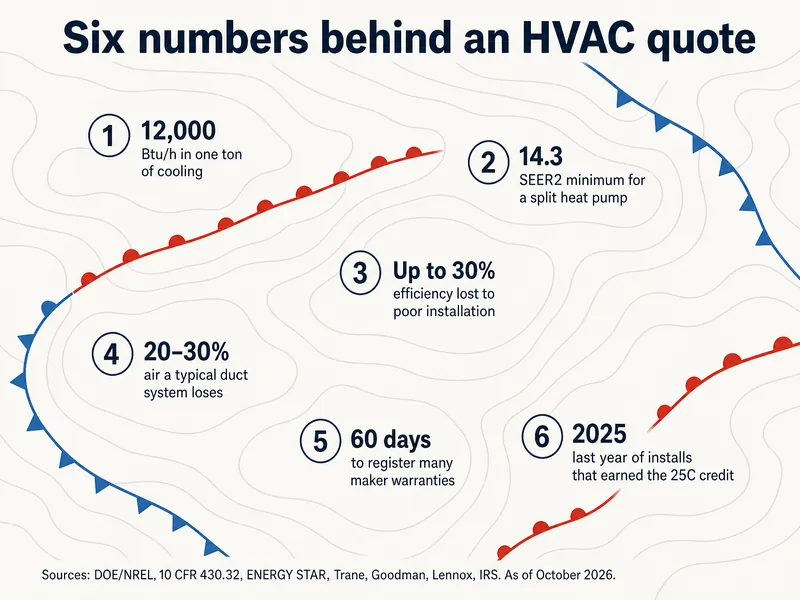
| Warranty | Maker pages: 60-day registration at Trane, Goodman, Lennox | Quotes section |
The right size is worked out from a room-by-room heating and cooling load, calculated with ACCA Manual J, then matched to equipment with Manual S; ducts are sized with Manual D. ENERGY STAR's heat pump page says the contractor should verify size "using a tool called 'Manual J'", and the International Residential Code (section M1401.3) calls for this method, though adoption and enforcement are local.
Oversizing costs comfort: ENERGY STAR links oversized equipment to frequent cycling, less comfort and shorter equipment life. The sizing section explains the Manual J load calculation, answers what size AC do I need and covers heat pump sizing for cold climates.
It depends on climate, fuel prices and the ducts, and a dual-fuel system pairs a heat pump with a furnace for the coldest hours. DOE puts heat pump savings at about 50 to 65 percent less electricity for heating than electric resistance heat (DOE home upgrades); that comparison is with electric baseboard or furnaces, not gas. For cold regions, ENERGY STAR's cold-climate criteria require a COP of at least 1.75 at 5°F and at least 70 percent of rated capacity at 5°F compared with 47°F.
Gas furnaces must reach 80% AFUE today. The CFR lists 95% for non-weatherized gas furnaces made from December 18, 2028, but an industry petition asks DOE to push that to 2030, so the date could change. The systems section compares a heat pump vs furnace, dual fuel heat pumps and furnace AFUE ratings.
Two things changed: the federal 25C and 25D credits ended for 2026 installs, and Home Energy Rebates were narrowed. The IRS OBBB FAQ says 25C "will not be allowed for any property placed in service after December 31, 2025". For 2025 installs, 25C was 30% of qualified costs, up to $2,000 for heat pumps and $600 per item for central AC or gas furnaces within a $1,200 cap, $3,200 in all, with the maker's QMID on the return.
DOE's Program Notice 26-2, effective May 29, 2026, renamed HEAR as High-Efficiency Electric Home Rebates, removed fuel switching and requires insulation and air sealing before HVAC upgrades. The federal ceilings remain up to $8,000 for a heat pump and $14,000 per household, through states; DOE says the rebates are available in select states. The costs section covers the heat pump tax credit, Home Energy Rebates in 2026 and repair or replace.
Four sets of rules apply: federal efficiency minimums, EPA refrigerant rules, local permits and carbon monoxide safety for fuel-burning equipment. Split central AC must reach 13.4 SEER2 in the North and 14.3 SEER2 below 45,000 Btu/h in the Southeast and Southwest, where the Southwest adds EER2 floors. New split systems made or imported from January 1, 2025 need a refrigerant under 700 GWP, per EPA's sector table; EPA's May 2026 rule lets older R-410A stock still be installed, and the rule is being challenged in court.
Permits are set by each city or county, and a fuel-burning furnace or boiler calls for working CO alarms on every level and outside sleeping areas. The rules section covers SEER2 regional minimums, the refrigerant change, permits and inspections and carbon monoxide safety.
The Second Bid is a homeowner's desk for reading heating and cooling decisions against federal rules, agency criteria and makers' own documents, with dates on every money and rule figure. It is not an HVAC contractor or a consultancy: it doesn't install, repair, size systems or review quotes. Advice here ends where a licensed HVAC contractor and your local code take over. More on what this site is and how pages are checked.
Observation notes
The home page draws on ACCA's description of Manual J; the federal efficiency table at 10 CFR 430.32; ENERGY STAR's hiring tips, heat pump criteria and duct sealing pages; DOE's home upgrades page; the IRS 25C page and OBBB FAQ; DOE's Home Energy Rebates page and Program Notice 26-2; EPA's refrigerant sector table and May 26, 2026 rule; and the 2026 furnace petition notice in the Federal Register, all read in October 2026. Left out: installed cost ranges, contractor rankings and forum stories.
No. It explains what a quote should show and what to ask, with sources, so you can judge the contractors you find yourself.
Not necessarily. It is often a smaller job: a different size, rating or scope. Compare the lines before the totals.
No. The IRS ended 25C for property placed in service after 2025. Home Energy Rebates may apply through your state, subject to the 2026 program changes.
No. EPA's FAQ answers that question with a yes for repairs, up to a new compressor or condensing unit, done by Section 608-certified technicians.
The CFR lists December 18, 2028 for 95% AFUE on non-weatherized gas furnaces, but a petition to delay it to 2030 is open with DOE, so treat the date as subject to change.
Often, but your city or county decides. Wheeling, Illinois requires one for any AC swap, while York County, Virginia waives it for a like-for-like electric condensing unit; ask the local building office.
ENERGY STAR's prompts are past 10 years for a heat pump or central air unit and past 15 for a furnace or boiler. Those are prompts to have it evaluated, not lifespans.