Heat Pump Tax Credit: What Ended After 2025
Is there still a heat pump tax credit? No: the federal 25C credit ended for heat pumps placed in service after December 31, 2025, so a 2026 install earns no credit (IRS, as of October 2026).
Read against its sources by The Second Bid · how pages are checked · Updated
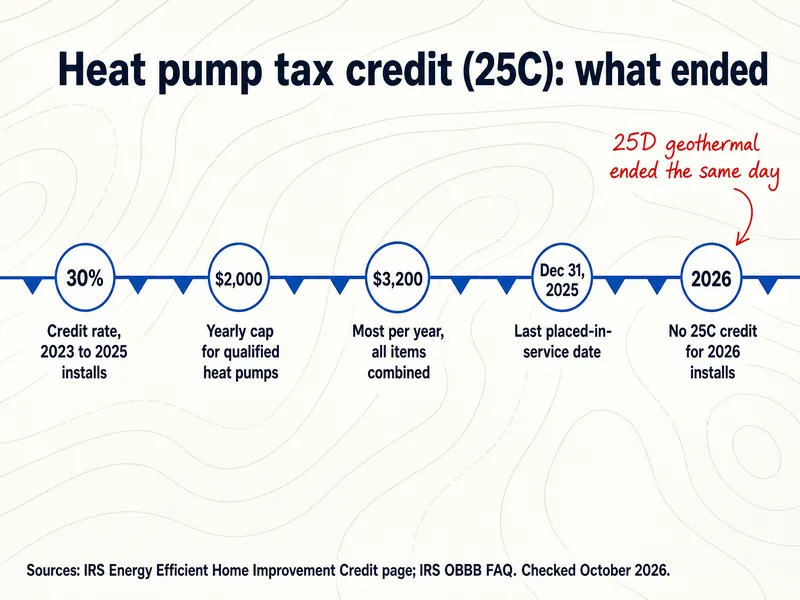
What 25C paid, and when it stopped
- 30%share of qualified costs credited, 2023 to 2025IRS
- $2,000yearly cap for qualified heat pumps (2025 returns and earlier)IRS
- $3,200most 25C could pay in one year, all items combinedIRS
- Dec 31, 2025last placed-in-service date for 25CIRS OBBB FAQ
Is there still a heat pump tax credit?
No federal heat pump tax credit applies to equipment installed in 2026. The 2025 federal budget law (Public Law 119-21) moved the end date forward, and the IRS table of termination dates gives 25C the last day of 2025: equipment that went into service in 2026 or later gets nothing. That covers air-source heat pumps, ducted or ductless, and every other 25C item.
Some pages still show the old end date: ENERGY STAR's air-source heat pump page, read in October 2026, still says installs through December 31, 2032 qualify, the date in force before the July 2025 change. Treat any quote, sales sheet or website that promises a 2026 federal heat pump credit as out of date. A line such as "qualifies for the 30% federal tax credit" on a 2026 proposal is a red flag worth asking about; our list of quote red flags covers other stale claims.
Line to look for
On a 2026 proposal
An example line such as "No federal 25C credit applies to this installation; see state rebate eligibility separately" tells you the installer is current.
Ask for
If a proposal mentions a credit, ask which program, which tax year and which document it relies on. A dated program page is the right answer; a brochure is not.
What did the 25C heat pump tax credit pay?
For property placed in service from January 1, 2023 through December 31, 2025, the credit equaled 30% of qualified costs, and the IRS notes that "costs may include labor for installation." Qualified heat pumps had their own ceiling of $2,000 a year; other items shared a $1,200 yearly cap.
The heat pump had to meet or exceed the Consortium for Energy Efficiency (CEE) highest efficiency tier, "not including any advanced tier," in effect at the start of the install year. The credit applied to an existing main home in the United States, not a new build, and it was nonrefundable: the IRS says "you can't apply any excess credit to future tax years."
| Item | Limit | Notes |
|---|---|---|
| Qualified heat pumps (air-source, including heat pump water heaters) | $2,000 a year | Separate from the $1,200 cap; CEE highest non-advanced tier |
| Central air conditioners | $600 per item | Inside the $1,200 yearly cap |
| Gas, propane or oil furnaces and hot water boilers | $600 per item | Inside the $1,200 yearly cap |
| Home energy audit | $150 | Written report required |
| All 25C items in one year | $3,200 | $2,000 heat pump cap plus $1,200 general cap |
What does placed in service mean?
Placed in service means the equipment is installed and ready to run, not merely bought or deposited on. The IRS says you "must claim the credit for the tax year when the property is installed, not merely purchased." So a heat pump paid for in December 2025 but commissioned in January 2026 falls outside 25C.
For 25D the IRS spells the timing out: an expenditure "is treated as made when the original installation of the item is completed." The IRS FAQ gives that answer only for 25D, so this site does not claim any deposit rule for 25C beyond the installed-not-purchased wording above. If your job straddled New Year, the date on the start-up or commissioning record is the evidence to keep.
Can you still claim a 2025 installation?
Yes. A heat pump placed in service on or before December 31, 2025 is claimed on the 2025 return with Form 5695, Part II. For 2025 items the IRS adds a condition: no credit "unless the item was produced by a qualified manufacturer" and you report its QMID on the return.
If you already filed without it, the IRS says a refund claim generally needs an amended return "within 3 years after the date you filed your original return or 2 years after the date you paid the tax, whichever is later." A tax professional can confirm whether your 2025 job qualifies.
When figuring a 2025 claim, the IRS says you may need to subtract "subsidies, rebates, or other financial incentives" from qualified costs, because they count as a purchase price adjustment. A utility rebate on the same heat pump lowers the cost the 30% applies to.
Ask for, on a 2025 install
The QMID
The maker's Qualified Manufacturer Identification Number for each unit, often printed on the maker's tax credit certificate or product page.
The completion date
A start-up sheet or invoice line showing the date the system was installed and running.
The model numbers
Outdoor and indoor model numbers, so the CEE tier can be checked against the matched system.
What about geothermal and 25D?
The 25D Residential Clean Energy Credit, which covered geothermal heat pumps at 30%, also ended. The IRS FAQ says it "will not be allowed for any expenditures made after December 31, 2025," and that paying in 2025 for a system completed in 2026 "will prevent the taxpayer from claiming the section 25D credit."
Two differences from 25C mattered while it ran: 25D had no annual dollar cap, and the IRS 25D page says you "can carry forward any excess unused credit." Geothermal heat pumps had to "meet Energy Star requirements in effect at the time of purchase." A 2025 geothermal install still goes on the 2025 Form 5695, in the Residential Clean Energy Credit part.
Which incentives may still apply?
With 25C gone, the money left for a 2026 heat pump is mostly state and utility money. The federal Home Energy Rebates run through states, and DOE says they are "now available in select states"; ceilings reach $8,000 for a heat pump, with income limits. Since DOE Program Notice 26-2 (May 29, 2026), those heat pump rebates cover replacing existing electric equipment or new construction, not swapping out a gas or oil furnace. The details are on our home energy rebates page.
Utilities and states also run their own offers. The ENERGY STAR Rebate Finder searches special offers by ZIP code. Ask the installer to put any rebate's name, amount and paperwork on the proposal, so you can compare bids the way how to compare HVAC quotes lays out.
Without a credit, the decision rests on operating cost and fit. Against electric baseboard or an electric furnace, DOE puts the heating electricity saved by a heat pump at roughly 50% (2022 booklet) to 65% (current web page); against gas, it depends on your local fuel prices. Heat pump vs furnace and the costs and credits hub walk through that choice.
Observation notes
This page reads the IRS Energy Efficient Home Improvement Credit page, the IRS FAQ on the Public Law 119-21 changes to 25C and 25D, the IRS Residential Clean Energy Credit page, the IRS amended return page, DOE's Home Energy Rebates program page and DOE Program Notice 26-2, all read October 27, 2026. Left out: cost ranges for heat pump installs (no primary source), state-by-state rebate status (not verified here), and tax advice for any individual return.
Outlook questions
Can a deposit paid in 2025 save the 25C credit for a 2026 install?
No source supports that. The IRS ties 25C to the tax year the property is installed, "not merely purchased," and for 25D it says completion after December 31, 2025 blocks the credit even when paid earlier.
Does a heat pump water heater installed in 2026 get a credit?
No. Heat pump water heaters were part of the same 25C $2,000 heat pump group, and 25C ended for anything placed in service after December 31, 2025.
Why does my installer's brochure still show a 2032 end date?
Before the July 2025 law, 25C was set to run through 2032, and some material, including an ENERGY STAR product page read in October 2026, still shows that date. The IRS FAQ now lists December 31, 2025 as the end.
What if my 2025 heat pump has no QMID?
For items placed in service in 2025, the IRS says no credit is allowed unless the item came from a qualified manufacturer and its QMID is reported. Ask the maker or installer for it before filing.
Can landlords claim 25C for a rental?
The IRS 25C page says you can't claim it as a landlord or other owner who doesn't live in the home; it was for your main home.
Do I subtract a utility rebate before figuring a 2025 credit?
Often yes. The IRS says rebates and subsidies may need to be subtracted from qualified costs as a purchase price adjustment, and that utility subsidies for clean energy property are subtracted.
Is there a 2026 federal credit for central air conditioners or furnaces?
No. The $600 per-item 25C limits for central AC, furnaces and boilers ended with the rest of 25C on December 31, 2025.
Further along the front