Whole Home Humidifiers: Types and Upkeep
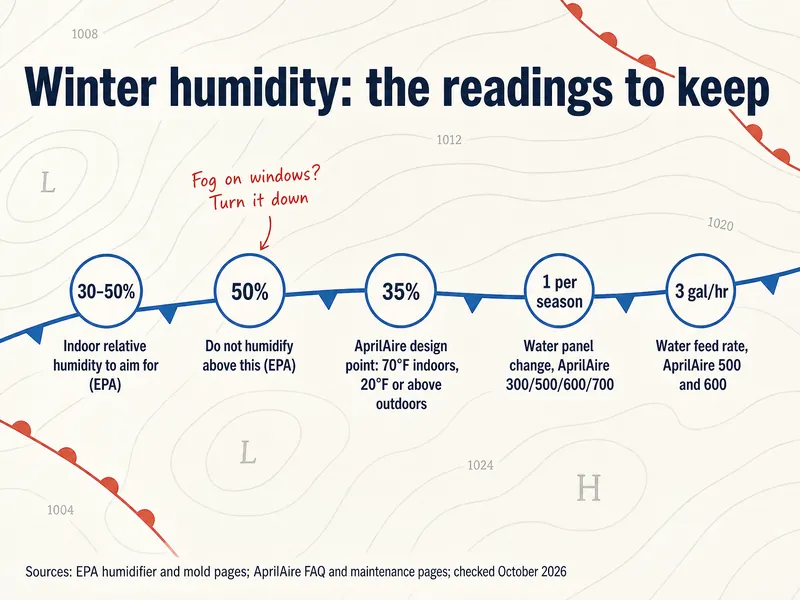
Whole home humidifiers add moisture to winter air through the furnace ducts, and EPA's target is an indoor relative humidity of about 30 to 50 percent, never above 50.
Read against its sources by The Second Bid · how pages are checked · Updated
Ties: Who is behind these links: The Second Bid is run by the same team that owns Plumbing Supply and More, SoftPro Water Systems and Quality Water Treatment, and that is connected to Central Plumbing & HVAC. No link here is paid placement. This page reads federal rules, ENERGY STAR and DOE criteria, ACCA's manuals and makers' own documents, checked in October 2026. Nothing was installed or measured by us; a linked business's description of its own goods is that business's claim. How these links work
Do you need a whole home humidifier?
You need a whole home humidifier only if your house runs below about 30% relative humidity for long stretches in winter, which you can check with a hygrometer before buying anything. EPA puts the healthy band at "ideally between 30 and 50 percent" on its mold and moisture page, and notes that inexpensive humidity meters measure it.
Cold outdoor air holds little water, so heated winter air in a leaky house often reads dry. EPA calls central humidifiers ones "built into heating and air conditioning systems" that "humidify the whole house", so they need forced-air heat or, for steam units, a duct or room location of their own. Before adding moisture, it is worth fixing the air leaks that let dry outdoor air in; the Manual J load calculation looks at the same envelope.
What humidity should a home hold?
A home should hold about 30 to 50 percent relative humidity, per EPA, and in very cold weather the right number is often nearer the low end. EPA's humidifier page says: "Do not humidify to indoor relative humidity levels exceeding 50 percent. Higher humidity levels may encourage the growth of biological organisms in the home." It adds that if water condenses on windows, walls or pictures, you should "lower its humidistat setting, or reduce its use".
Maker controls handle the cold-weather adjustment for you. AprilAire's FAQ says its outdoor temperature sensor "is what allows your AprilAire Humidifier to be an automatic humidifier", and that its units are designed around 35% at 70°F indoors when it is 20°F or above outside. When window fog appears, the setting is too high for that day's weather.
Humidity numbers on the record
- 30–50%Indoor relative humidity EPA calls idealEPA
- 50%Level EPA says not to humidify aboveEPA
- 35%AprilAire design point at 70°F indoors, 20°F or above outdoorsAprilAire
- 3 gal/hrWater feed rate, AprilAire Models 500 and 600AprilAire
- 2 a seasonWater panel changes for the AprilAire 45 panel (once a season for the 10, 12 and 35)AprilAire
Bypass, fan-powered or steam?
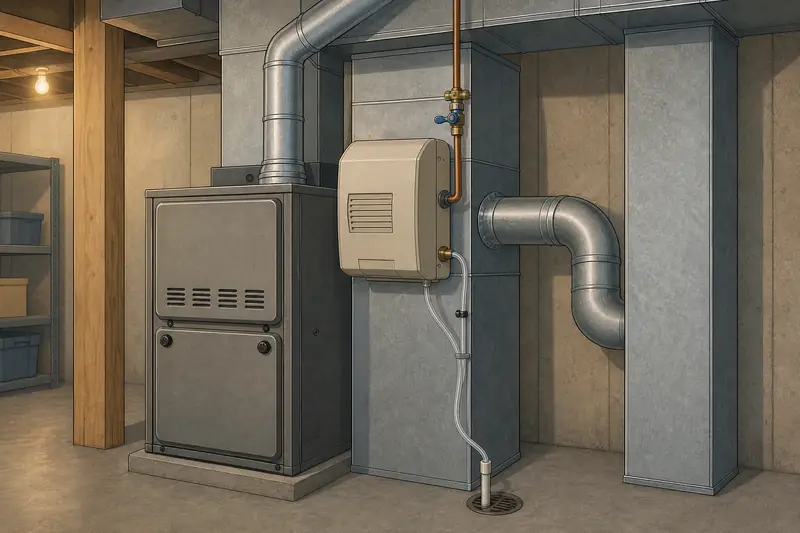
Choose by output and by what the house has: bypass for a typical forced-air home, fan-powered for more output without a bypass duct, steam for big loads or homes without forced-air heat. AprilAire says its bypass units "get their air movement through the water panel by the differential pressure between the supply (hot air) plenum and the return (cold air) duct"; a small duct links the two.
| Type | How it moves moisture | Needs | Yearly part (AprilAire) |
|---|---|---|---|
| Bypass evaporative (e.g. Models 500, 600) | Furnace air pushed through a wet water panel by duct pressure | Forced-air furnace, bypass duct, drain | Water panel |
| Fan-powered evaporative (e.g. Model 700) | Its own fan blows air through the water panel | Forced-air system, drain, power | Water panel |
| Drain-free evaporative (Model 400) | Recirculates water through the panel | Forced-air system | Water panel, twice a season |
| Steam (Model 800) | Boils water into vapor | Power circuit, water line; can work without forced air | Steam canister and O-ring |
AprilAire describes its Model 800 steam unit as designed for spaces such as crawlspaces and attics, milder winters, and homes "with non-forced air heating". A supply house's humidifier range (Plumbing Supply and More, run by the same team as The Second Bid) shows the three families side by side, for the installer to quote against.
How does hard water affect whole home humidifiers?
Hard water scales the water panel of an evaporative humidifier and the canister of a steam unit, so parts clog sooner and output drops. AprilAire explains that "some of the minerals left behind from the evaporation process are permanently trapped in the water panel", which "will eventually become clogged with these minerals so less evaporation takes place".
The maker's answer to soft versus hard water is direct: "It is recommended soft or softened water be used for optimum performance," and its evaporative units "will perform with hard or soft water, but hard water can increase scale buildup and require additional maintenance". AprilAire also mentions an inline scale-reducing filter as an option.
Whole-house evaporative and steam units are not the "white dust" type. EPA says ultrasonic and impeller humidifiers "are very efficient at dispersing minerals in tap water into the air", while steam and evaporative ones are "not expected to disperse substantial amounts of minerals". Where a water test shows hard water, a softener on the line that feeds the humidifier is one option; the SoftPro ECO softener sold by Quality Water Treatment (Quality Water Treatment, run by the same team as The Second Bid) is one example of that equipment. Test first: if the water is already soft, there is nothing to gain.
What upkeep do they need?
Upkeep is one water-panel or canister change a year, a seasonal on/off step, and a look at the drain. AprilAire's maintenance page says: "Replace the water panel annually (Models 300, 500, 600, 700, and 720) or twice per heating season (Model 400)", and for steam units, "Replace the steam canister and O-ring annually", with electrode wires replaced every three years "by a licensed contractor". Turn the unit's power and water off before any panel or canister change, or leave it to a technician.
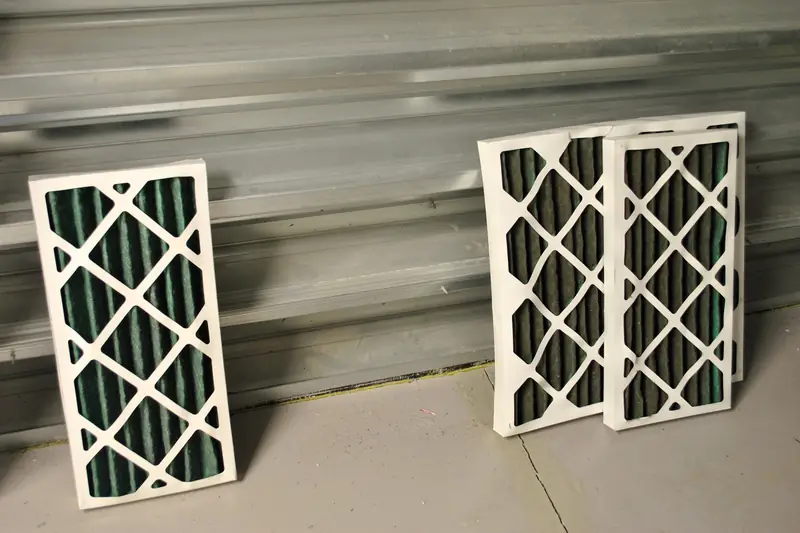
For summer, AprilAire's FAQ says bypass models 400, 500 and 600 shut down by closing the bypass damper "with the small damper handle"; the Model 700 and 800 only need the control adjusted. Panel changes follow the maker's owner steps with the furnace off. The water line, drain connection and wiring are installer work, and a leak, a wet duct or a tripping breaker is a reason to stop and call a licensed HVAC technician. Keep the furnace filter on its own schedule too: check it monthly and replace it at least every 3 months, per ENERGY STAR.
What should a humidifier quote include?
A humidifier quote should name the model and type, where it mounts, how it gets water, where it drains and which control runs it. AprilAire's FAQ adds two details worth seeing in writing: bypass units mount on the supply plenum or the return duct with a bypass between them, and every model uses "a water-metering orifice" to regulate flow, so the saddle or supply valve is simply turned to full open.
On the humidifier bid
Line to look for
Written well, it reads like: "Install AprilAire 600 bypass humidifier on supply plenum, 6-inch bypass to return with damper, 1/4-inch water supply with valve, drain to condensate line or floor drain, automatic digital control with outdoor sensor."
Ask for
Where the drain water goes, and a drain pump if no floor drain is close; installation extras covers condensate pumps.
Ask for
The water panel or canister part number, so you can order the yearly replacement yourself.
Ask for
A note on water hardness: whether a scale-reducing filter or softened water is advised for your water test.
A humidifier on a fuel-burning furnace does not change carbon monoxide rules; keep CO alarms on every floor, as the carbon monoxide safety page explains. To check the rest of a heating bid, see what an HVAC quote should include.
Observation notes
This page reads EPA's home humidifier page and its mold and moisture booklet, AprilAire's owner FAQ and humidifier maintenance pages, and ENERGY STAR's heating and cooling booklet, checked during October 2026. Missing on purpose: installed prices, health claims beyond EPA's wording, and portable or room humidifier reviews.
Outlook questions
Will a whole home humidifier cause mold?
It can if set too high. EPA says not to humidify above 50 percent and to turn the setting down when water condenses on windows or walls; an automatic control with an outdoor sensor lowers the target as it gets colder.
Does a bypass humidifier waste water?
Evaporative units send some water to the drain to flush minerals; AprilAire lists a feed rate of 3 gallons per hour for its Models 500 and 600 while running. Its drain-free Model 400 recirculates water and needs more frequent panel changes.
Can a whole home humidifier work with a heat pump?
It can be fitted to a ducted heat pump system. Evaporation depends on warm air passing the panel, so ask the installer which type the humidifier maker lists for heat pumps and what output to expect on your system.
Is white dust a problem with whole-house units?
Not usually. EPA links white dust to ultrasonic and impeller humidifiers; it says steam and evaporative units are not expected to disperse substantial amounts of minerals.
How do I know the water panel needs changing?
On AprilAire units, a change-water-panel light on the digital control prompts it, and the maker sets yearly or twice-a-season intervals by model. A crusted, stiff panel or falling humidity readings are the other signs.
Should the humidifier run in summer?
No. Close the bypass damper or set the control off at the end of the heating season, per AprilAire, and let the air conditioner remove moisture instead.
Further along the front