Heat Pump vs Furnace: How to Decide
Heat pump vs furnace comes down to four things: your winter design temperature, local electric and gas prices, the ducts and electrical panel you have, and what changed for credits and rebates in 2026.
Read against its sources by The Second Bid · how pages are checked · Updated
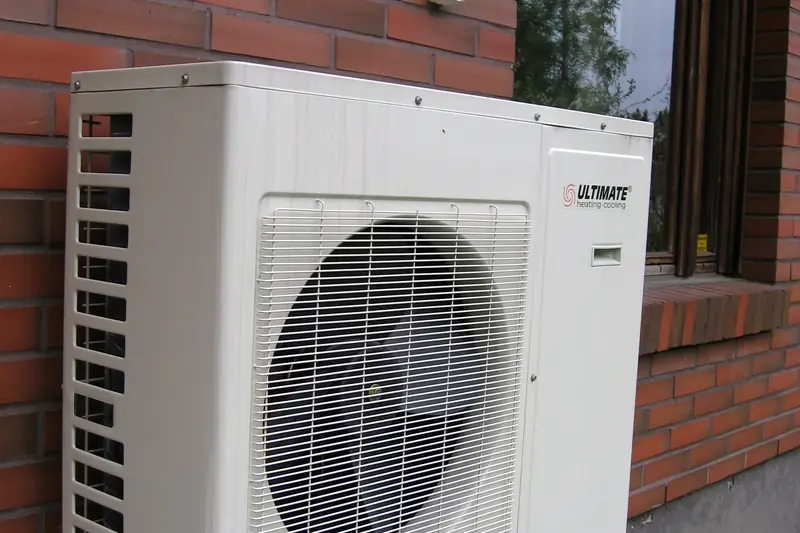
Heat pump vs furnace: which suits your home?
A heat pump suits homes with mild to moderate winters, ducts in decent shape and electricity that is not expensive next to gas; a furnace suits homes with very cold winters, cheap gas and no plan to add cooling. Most homes fall between, which is why a third option, the dual fuel heat pump, exists.
The two machines work differently. A gas furnace burns fuel and its AFUE says what share of that fuel becomes heat. A heat pump moves heat from outdoor air into the house and also runs in reverse as the air conditioner; ENERGY STAR says an air-source unit can deliver "up to three times more heat energy to a home than the electrical energy it consumes" (ENERGY STAR).
| Point | Air-source heat pump | Gas furnace |
|---|---|---|
| Efficiency rating | SEER2 (cooling), HSPF2 (heating) | AFUE |
| Federal minimum | 14.3 SEER2 / 7.5 HSPF2 split (10 CFR 430.32) | 80% AFUE non-weatherized; 95% listed for units made from Dec 18, 2028 |
| ENERGY STAR level | 15.2 SEER2 / 7.8 HSPF2 split | 97% North, 95% South |
| Also cools | Yes | No; needs a separate AC |
| Fuel on site | None | Gas line, venting, CO alarms |
| Cold weather | Output drops; backup often needed | Output does not fall as the outdoor air cools |
How efficient is a heat pump compared with a furnace?
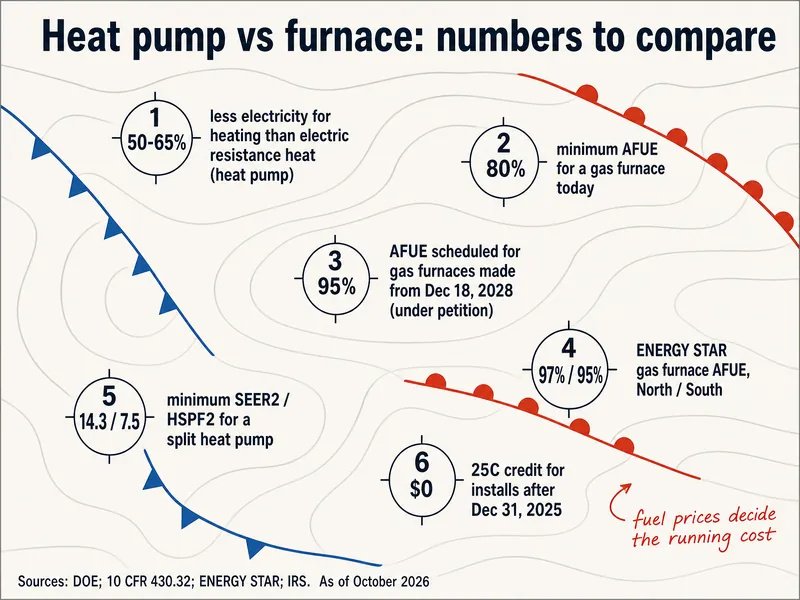
Against electric resistance heat, DOE puts a heat pump's saving at about 50 to 65% of the electricity used for heating; against gas, there is no single figure, because the answer depends on prices. DOE's home upgrades page says "approximately 65%," and DOE's 2022 Energy Saver booklet says about 50%, both measured against furnaces and baseboards that heat with electric resistance.
A gas furnace's efficiency is capped below 100% by definition: the ENERGY STAR furnace page defines AFUE as the percentage of the fuel's heat converted to space heat. A heat pump's coefficient of performance (COP) can exceed 1 because it moves heat rather than making it. Comparing a COP with an AFUE only becomes a cost comparison once you put a price on each unit of gas and electricity.
Numbers with a source
- 50-65%cut in heating electricity versus electric resistance heatersDOE
- 80%AFUE floor for indoor (non-weatherized) gas furnaces until the 2028 date10 CFR 430.32
- 97% / 95%ENERGY STAR gas furnace AFUE, North / SouthENERGY STAR
- 14.3 / 7.5minimum SEER2 / HSPF2 for split heat pumps10 CFR 430.32
How do heat pumps handle cold weather?
Heat pumps lose output and efficiency as the outdoor air gets colder, and how fast depends on the model. PNNL's page on standard split heat pumps (2017) says their heating efficiency drops below about 35°F, so a backup source is often needed; ENERGY STAR's cold climate models must keep a COP of at least 1.75 and at least 70% of their 47°F capacity at 5°F.
So the cold-weather question is a sizing question. Read the quoted model's output at your local design temperature against your heating load, as set out in cold climate heat pump sizing. Thermostat habits matter too: a big manual setback can pull in expensive strip heat on recovery, which DOE avoids with a thermostat built for heat pumps and ENERGY STAR avoids by leaving the setpoint alone.
What do fuel prices change?
Fuel prices decide which system is cheaper to run, because the efficiency numbers only tell you how much heat each unit of energy buys. Take the price per kilowatt-hour and per therm from your own utility bills, and ask the installer to run the operating-cost comparison for your home with the quoted model's ratings and those rates.
That is also why ENERGY STAR frames dual fuel around cost: such systems let you use each heat source "optimally based on costs and environmental benefits" (ENERGY STAR). If gas is cheap where you live and winters are long, a high-AFUE furnace with a separate AC may cost less to run; where electricity is cheap or gas isn't available, the heat pump usually leads.
Ask for: "an annual heating cost estimate for each option using my utility rates, the model's HSPF2 or AFUE, and the Manual J heating load."
What about the ducts and the electrical panel?
Both systems usually share the same ducts, but a switch to a heat pump is the moment to check them, and some homes need electrical work. DOE says "in some homes, a panel upgrade may be needed to add new electrical equipment, such as an electric heat pump" (home upgrades). Ask whether the quote includes a circuit for the outdoor unit and any strip heater, and whether the panel has room.
On ducts, the new unit's airflow should be checked against the existing runs; see Manual D duct design. A gas furnace brings its own checks: venting, combustion air, and CO alarms outside sleeping areas and on each floor, per CPSC, with yearly service by a qualified technician; CO safety covers what to do if an alarm sounds.
What changed for heat pumps in 2026?
Three things changed: the federal tax credit ended, the state rebates narrowed, and the refrigerant rules eased. The IRS FAQ rules out the 25C credit for property placed in service in 2026 or later; a heat pump installed in 2025 could still claim 30% up to $2,000 on the 2025 return (heat pump tax credit).
DOE's Program Notice 26-2, effective May 29, 2026, renamed the state rebates High-Efficiency Electric Home Rebates and removed fuel switching: a heat pump replacing a gas or oil furnace no longer qualifies, while electric-to-electric replacements and new construction remain, with insulation and air sealing first. Federal ceilings are still up to $8,000 for a heat pump where a state offers it; see home energy rebates.
New heat pumps made since January 1, 2025 use refrigerants under 700 GWP such as R-454B or R-32, and EPA's May 2026 final rule lets pre-2025 R-410A equipment still be installed, a rule now challenged in court (refrigerant transition). For gas, the 95% AFUE furnace date is scheduled, under petition and could change; DOE asked for comment on the delay request on April 27, 2026.
Observation notes
This page is based on DOE's home upgrades page and 2022 Energy Saver booklet, ENERGY STAR's air-source heat pump and furnace criteria pages, 10 CFR 430.32 (eCFR, October 2026), the April 27, 2026 Federal Register petition notice, the IRS 2025 law FAQ, DOE Program Notice 26-2, CPSC's carbon monoxide page and PNNL's split heat pump page (2017), read in October 2026. Left out: operating-cost or install-cost figures (they depend on local rates and the house), a "heat pumps save X% versus gas" claim (no primary source), and forum anecdotes.
Outlook questions
Is a heat pump cheaper to run than a gas furnace?
Sometimes. It depends on your electric and gas rates, the heat pump's HSPF2 and the furnace's AFUE. Run the numbers with your own utility rates before deciding.
Can I keep my furnace and add a heat pump?
Yes, that is a dual fuel system: the heat pump takes the place of the central AC, heats in mild weather, and the furnace takes over in the cold. It needs a thermostat that controls both.
Does a heat pump work in a power outage?
No. A heat pump needs electricity; a gas furnace also needs power for its blower, igniter and controls, so neither runs without power or a generator sized for it.
Will the 95% AFUE rule force me to replace my furnace?
No. The rule in 10 CFR 430.32 applies to furnaces made on or after December 18, 2028, not to furnaces already installed, and the date is under petition.
How long does a heat pump last compared with a furnace?
PNNL's Building America pages give 15 to 20 years as the typical lifespan of HVAC equipment, without splitting it by type. ENERGY STAR suggests having a heat pump evaluated after about 10 years and a furnace after 15; those are review points, not end dates.
Can I still get a rebate for replacing a gas furnace with a heat pump?
Not under the federal home energy rebates since Program Notice 26-2 took effect on May 29, 2026. Utility or state-funded programs outside that federal program have their own rules, so ask your state energy office.
Further along the front
Back to The Second Bid front page