What Size AC Do I Need?
What size AC do I need? The one your home's Manual J heat-gain load calls for, usually stated in Btu/h; a ton is 12,000 Btu/h, and square footage alone can't set it.
Read against its sources by The Second Bid · how pages are checked · Updated
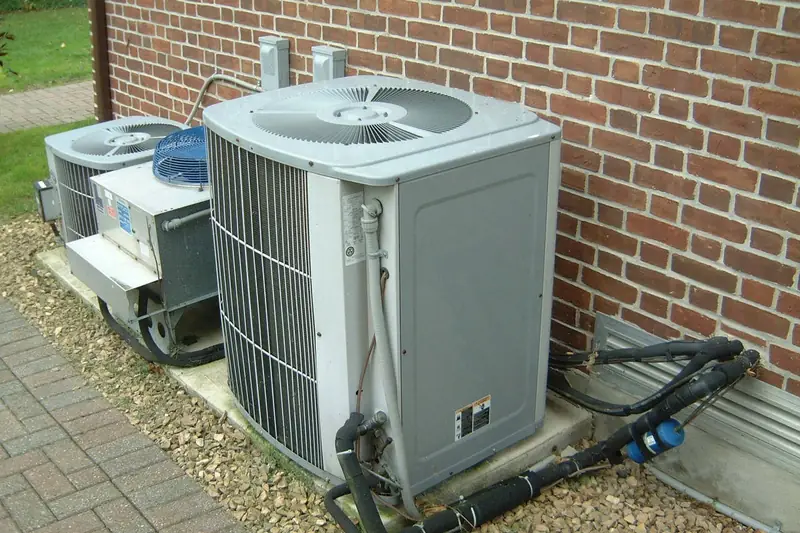
What size AC do I need, in plain terms?
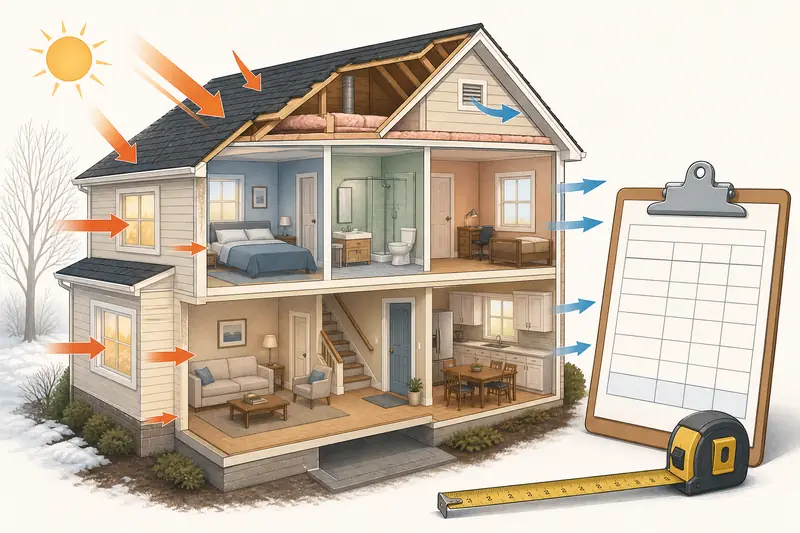
The AC size you need is the cooling capacity that matches your home's calculated heat gain on a typical hot day for your area. That heat gain comes from a Manual J load calculation, which totals sun through windows, heat through walls and roof, air leakage, people and ducts. ENERGY STAR warns that a system "either too large or too small for its intended space will struggle to meet your home comfort needs."
So the honest answer to "what size AC do I need" is a number in Btu/h, not a guess from the listing for your house. Two homes of the same floor area can land a ton apart because of windows, insulation and shade.
What does a ton of AC mean?
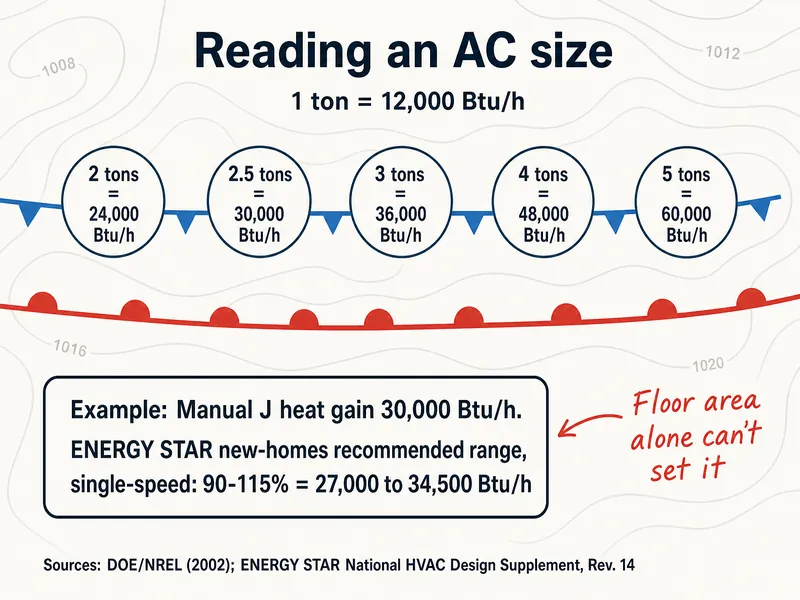
A ton of AC means 12,000 Btu/h of cooling capacity, a standard trade unit. DOE's 2002 Right-Size sheet uses it the same way, listing "2 ton (24,000 Btu/hr)" and "4.0 to 4.5 ton (48 to 54,000 Btu/hr)".
Model numbers often carry the size in code, so read the maker's spec sheet for the stated capacity rather than guessing from the label. Nominal tonnage is also not the delivered capacity: Manual S checks the matched outdoor and indoor units at your design temperature and airflow.
| Nominal size | Btu/h | Where it is stated |
|---|---|---|
| 2 tons | 24,000 | Model number, spec sheet |
| 2.5 tons | 30,000 | Model number, spec sheet |
| 3 tons | 36,000 | Model number, spec sheet |
| 4 tons | 48,000 | Model number, spec sheet |
| 5 tons | 60,000 | Model number, spec sheet |
Why don't square-foot charts give the AC size you need?
Square-foot charts ignore most of what sets the load. DOE's 2002 sheet tells homeowners to "beware of casual sizing estimates" built on floor area or a contractor's "experience", and ENERGY STAR's quality installation page says not to "just rely on a 'rule of thumb.'" Windows facing west, an attic with thin insulation or ducts in a hot attic can each change the answer.
The same DOE sheet reported that in one large survey nearly 40 percent of contractors said they oversized on purpose, citing call-backs or customer demand. That is why this site prints no square-feet-per-ton figure. The HVAC quote red flags page lists square-foot sizing as a line to question.
How do you check the size in a quote?
You check the size by setting the proposed capacity beside the Manual J heat gain. ENERGY STAR's new-homes sizing table defines "cooling sizing %" as total capacity divided by maximum total heat gain. For new homes in its program, single-speed equipment is recommended at 90–115%, two-speed at 90–120% and variable-speed at 90–130%.
Those percentages are an ENERGY STAR program rule, not a law for your replacement, but they are a published yardstick. If the heat gain is 30,000 Btu/h, a single-speed unit delivering 27,000 to 34,500 Btu/h falls in the recommended band.
Line to look for, and what to ask for
Line to look for
An example line such as: "Load per Manual J: 30,200 Btu/h sensible + latent. Selected: 2.5-ton condenser with matched coil, 29,600 Btu/h at 95°F outdoor."
Ask for
The Manual J summary page with heat gain in Btu/h, and the Manual S capacity of the exact matched outdoor and indoor units.
Ask for
The AHRI-matched rating for the pair, so the SEER2 printed in the quote belongs to the coil you're actually getting.
Efficiency is a separate line from size. Federal rules under 10 CFR 430.32 set split AC minimums of 13.4 SEER2 in the North and 14.3 SEER2 in the Southeast and Southwest below 45,000 Btu/h; the SEER2 minimums page has the full table.
Is it better to oversize or undersize an AC?
Neither; the target is a close match, and the published limits allow a little more capacity rather than less. ENERGY STAR's program table starts at 90% of the load and allows up to 115% recommended for single-speed units. DOE's 2002 sheet adds that Manual J and S "have sufficient built-in safety factors", so adding a ton "to be safe" stacks margin on margin.
Oversizing has documented costs: short cycling, weaker humidity control and more wear. A Florida study DOE cited found that badly oversized units burned noticeably more cooling electricity over a year. The details are on the oversized AC problems page.
What if the old unit felt too small?
A unit that felt too small often had a problem other than size. ENERGY STAR's replacement checklist links hot rooms to "an undersized duct system or a problem with the indoor coil", and says leaky ducts, poor equipment operation and inadequate insulation can also be the cause. ENERGY STAR estimates a fifth to nearly a third of duct air leaks away in a typical home.
Low refrigerant charge, a dirty coil and poor airflow can also cut delivered capacity, and ENERGY STAR asks contractors to test the charge and airflow at install. Before buying a bigger unit, ask for a load calculation and a duct check. If you're unsure, stop and call a licensed HVAC technician; refrigerant work needs EPA Section 608 certification.
AC size numbers
- 12,000Btu/h in one ton of coolingDOE/NREL worked example, 2002
- 90–115%single-stage capacity band ENERGY STAR recommendsENERGY STAR new-homes sizing table
- Nearly 40%of contractors surveyed said they oversized on purposeDOE/NREL right-sizing sheet
- 14.3minimum SEER2, split AC under 45,000 Btu/h, Southeast and Southwest10 CFR 430.32
Observation notes
Based on ENERGY STAR's air-source heat pump, quality installation, replacement and duct sealing pages, ENERGY STAR's new-homes sizing table (2025 revision), DOE/NREL's 2002 right-sizing sheet and 10 CFR 430.32 on eCFR, checked in October 2026. The sample quote line and the 30,000 Btu/h worked example are illustrations, not a real home's figures. Left out: square-feet-per-ton charts, installed prices and brand comparisons.
Outlook questions
What size AC do I need for a 2,000 square foot house?
There is no single answer from floor area. The size comes from the house's Manual J heat gain, which depends on windows, insulation, air leakage, ducts and climate; ask for that number in Btu/h.
Is 3 tons the same as 36,000 BTU?
Nominally, yes: 3 tons times 12,000 Btu/h is 36,000 Btu/h. The capacity the unit actually delivers at your design temperature can be lower or higher, which is what Manual S checks.
Does a higher SEER2 mean a bigger AC?
No. SEER2 measures seasonal efficiency, and tons or Btu/h measure capacity. A 2-ton unit can carry a high SEER2 and a 4-ton unit a low one.
Should the new AC match the furnace blower?
The blower has to move enough air for the cooling coil. Ask the installer to confirm the furnace or air handler airflow suits the new tonnage; ENERGY STAR asks that airflow meet "manufacturer performance specifications."
Can a two-stage AC be a size larger?
ENERGY STAR's new-homes table allows a wider band for two-stage units, 90–120% recommended, and for variable-speed units, 90–130%. That is a program rule, not a reason to skip the load calculation.
Why did two quotes give different AC sizes?
Usually because one used a load calculation and one didn't, or their inputs differ. The quote comparison page shows how to line up the size lines first.
Further along the front
Back to The Second Bid front page