Furnace AFUE Ratings: 80% vs 95%
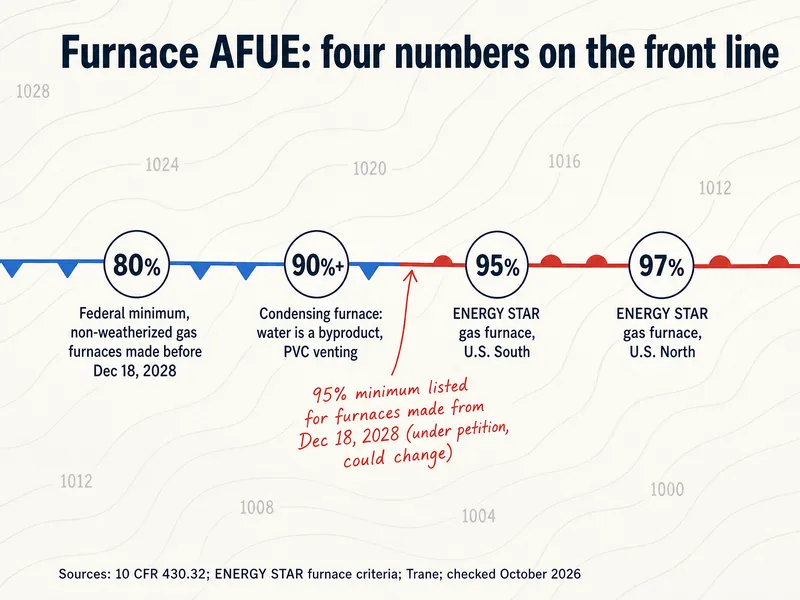
Furnace AFUE ratings tell you what share of a season's fuel becomes house heat: 80% is today's federal floor for most gas furnaces, while 90% and up means a condensing furnace with PVC venting.
Read against its sources by The Second Bid · how pages are checked · Updated
Ties: Who is behind these links: The Second Bid is run by the same team that owns Plumbing Supply and More, SoftPro Water Systems and Quality Water Treatment, and that is connected to Central Plumbing & HVAC. No link here is paid placement. This page reads federal rules, ENERGY STAR and DOE criteria, ACCA's manuals and makers' own documents, checked in October 2026. Nothing was installed or measured by us; a linked business's description of its own goods is that business's claim. How these links work
What do furnace AFUE ratings measure?
Furnace AFUE ratings measure seasonal fuel efficiency: the share of the gas, oil or propane burned over a heating season that ends up as heat in the house. An 80% AFUE furnace turns about 80 of every 100 units of fuel heat into house heat; the rest leaves through the vent. ENERGY STAR defines the term as the percentage of the fuel's heat "converted to space heat instead of being lost" on its furnace criteria page.
AFUE covers the burner and heat exchanger, not your ducts. ENERGY STAR says a typical house loses "about 20 to 30 percent of the air" moving through ducts to leaks and poor connections (duct sealing page), and none of that loss shows up in the rating. A 96% furnace on leaky attic ducts can deliver less heat to the rooms than its label suggests, which is why Manual D duct design belongs in the same conversation.
What is the difference between 80% and 95% AFUE?
The difference between 80% and 95% AFUE is condensing. A 95% furnace pulls so much heat out of the exhaust that water vapor condenses, and that condensing step is where the extra efficiency comes from. ENERGY STAR's 2009 heating and cooling booklet says condensing "occurs with systems over 90 percent efficient" (PDF).
Trane's explainer lists what that changes in the basement: a secondary heat exchanger, a condensate drain line, and exhaust "cool enough to exit your home through a special venting system using PVC pipe". An 80% furnace, by contrast, sends hot exhaust "through a metal flue pipe, and up your chimney", in Trane's words. So the jump from 80% to 95% is not only a model swap; it often means new pipes through an outside wall and a drain.
| Furnace | AFUE | Venting and drain | Where the number comes from |
|---|---|---|---|
| Non-weatherized gas furnace, federal floor | 80% | Metal flue, often a chimney | 10 CFR 430.32(e)(1)(ii) |
| Weatherized (outdoor, packaged) gas furnace | 81% | Built into the packaged unit | 10 CFR 430.32(e)(1)(ii) |
| Non-weatherized oil furnace | 83% | Chimney or listed vent | 10 CFR 430.32(e)(1)(ii) |
| Condensing gas furnace | 90% and up | PVC intake and exhaust, condensate drain | ENERGY STAR 2009 booklet; Trane |
| ENERGY STAR gas furnace, U.S. South | 95% or more | Condensing | ENERGY STAR key product criteria |
| ENERGY STAR gas furnace, U.S. North | 97% or more | Condensing | ENERGY STAR key product criteria |
What is the federal AFUE minimum?
The federal AFUE minimum today is 80% for non-weatherized gas furnaces made from November 19, 2015 until December 18, 2028, under 10 CFR 430.32. Weatherized gas furnaces must reach 81% and non-weatherized oil furnaces 83%. The rule follows the date the furnace was made, not the date it goes in.
The same section lists 95% AFUE for non-weatherized gas furnaces made on and after December 18, 2028. DOE announced that standard in 2023 (DOE news release). On April 27, 2026 DOE published a gas-industry petition asking to push the compliance date to January 1, 2030 or later, and asked for comment (Federal Register). As of October 2026 the 2028 date is scheduled, under petition, and could change.
Furnace numbers on the record
- 80%AFUE floor, non-weatherized gas furnaces made before Dec 18, 202810 CFR 430.32
- 95%AFUE listed for gas furnaces made from Dec 18, 2028 (under petition)10 CFR 430.32
- 97%ENERGY STAR minimum AFUE, U.S. North gas furnacesENERGY STAR
- 95%ENERGY STAR minimum AFUE, U.S. South gas furnacesENERGY STAR
What venting does a condensing furnace need?
A condensing furnace needs its own sealed venting, usually PVC intake and exhaust pipes run through a wall or roof, plus a drain for the condensate. Trane says a switch from a conventional furnace "is not simply a plug-and-play installation": installers add a condensate drain line and PVC supply and exhaust pipe and drill holes in an exterior wall. The pipe material, diameter, maximum length and termination clearances come from that furnace's installation manual, not from a general rule.
ENERGY STAR's 2009 quality-installation checklist asks the contractor to verify "proper venting of flue gases" and to inspect vent piping "for leaks or deterioration". Two quote lines follow from that.
Venting lines on a furnace quote
Line to look for
An example line such as: "Vent new 96% furnace in 2-pipe PVC per manufacturer's installation manual, sidewall termination, condensate drain to floor drain with trap."
Ask for
Where the condensate goes in winter, and how a gas water heater that shared the old chimney will be vented once the furnace leaves it.
Ask for
The permit. Many places require one to replace a fuel-fired furnace; see permits and inspections.
Any fuel-burning furnace is a carbon monoxide source. CPSC says to put CO alarms "on every level of the home and outside sleeping areas" and to have the heating system "professionally inspected and serviced annually" (CPSC carbon monoxide page). If an alarm sounds or anyone feels sick, get everyone outside to fresh air, then call 911 or the fire department. More on alarms is in carbon monoxide safety.
Which furnace parts fail most?
The small ignition and safety parts fail most often. Carrier's furnace parts page says the heat exchanger and blower motor "can last 15–20 years with proper maintenance", while "smaller components like igniters, flame sensors, and capacitors may need replacement sooner due to normal wear and tear" (Carrier). That is a maker's description, not a failure study.
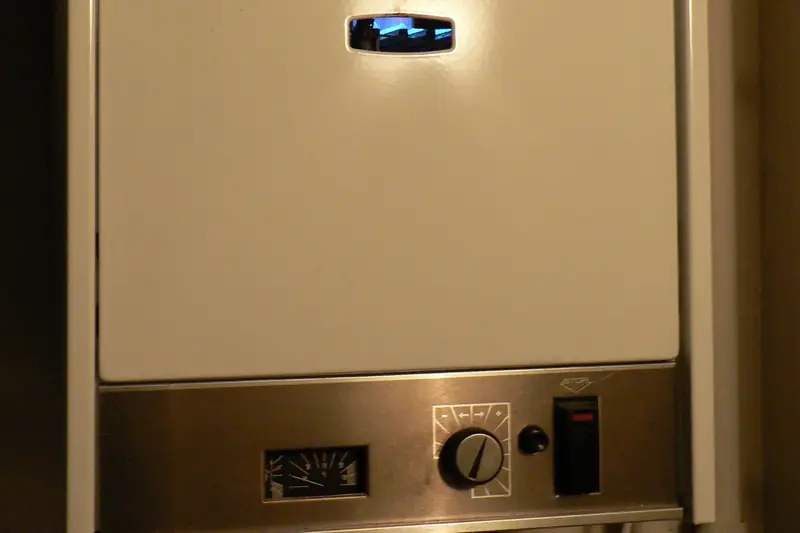
Most modern furnaces light with a hot surface igniter; Carrier notes that "if the igniter fails, the furnace will not be able to produce heat." The flame sensor shuts off the gas when it can't prove a flame, and Carrier says that "bypassing or removing the flame sensor is dangerous and should never be attempted" (flame sensor page). Older standing-pilot furnaces use a thermocouple in the pilot flame for the same proof-of-flame job.
These parts are sold by shape and rating, and knowing the name helps you read a repair ticket. A supply house's hot surface igniter range (Plumbing Supply and More, run by the same team as The Second Bid) shows how they are sold by shape and voltage, for your technician to quote against; the work itself is inside the burner compartment and belongs to a licensed technician. Homeowner checks stop at the filter, thermostat batteries and settings, and the furnace switch and breaker (reset a tripped breaker once; if it trips again, leave it off). If you smell gas, leave the house and call the gas utility's emergency line or 911 from outside. If you're unsure, stop and call a licensed HVAC technician.
When is a higher AFUE worth it?
A higher AFUE is worth most where winters are long and gas is the main heat, which is why ENERGY STAR sets the bar at 97% in the North and 95% in the South. ENERGY STAR says certified northern gas furnaces are "up to 18 percent more energy efficient than baseline models" and southern ones up to 16 percent (ENERGY STAR furnaces). In a mild climate with a short heating season, the extra venting and drain work buys fewer saved therms.
Three other points weigh in. A furnace made after December 18, 2028 may have to be 95% anyway if the rule holds. Federal 25C credits ended for equipment placed in service after December 31, 2025, so no federal credit offsets the difference in 2026 (see heat pump and furnace tax credits). And if you are weighing gas against electric, heat pump vs furnace and dual-fuel heat pumps cover the options. Whatever the AFUE, the size should come from a Manual J load calculation, not from the old furnace's nameplate.
Observation notes
This page reads 10 CFR 430.32 (eCFR text dated October 23, 2026), DOE's 2023 furnace standard release, the Federal Register petition notice of April 27, 2026, ENERGY STAR's furnace criteria and 2009 heating and cooling booklet, CPSC's carbon monoxide safety page, and Carrier and Trane homeowner pages, all read in October 2026. Left out: installed prices (no primary source publishes them), fuel-savings dollar estimates, and any repair steps inside the burner compartment.
Outlook questions
Is a 96% AFUE furnace worth it over a 95%?
One point of AFUE changes seasonal fuel use by roughly one percent, so the choice usually turns on other features, such as a variable-speed blower or modulating burner, and on price. Both clear ENERGY STAR's South level; only 97% and up clears the North level.
Can an 80% furnace still be installed in 2026?
Yes. The CFR allows 80% AFUE for non-weatherized gas furnaces made before December 18, 2028, and the rule follows the manufacture date. Ask the installer and the building department whether any local rule or utility program asks for more.
Does a 95% furnace need a chimney?
No. A condensing furnace vents through its own PVC pipes, usually out a side wall or roof. The old chimney may still serve other appliances, such as a gas water heater, which is why the vent plan for those belongs on the quote.
What happens to the condensate from a 95% furnace?
It drains through a small pipe to a floor drain or a condensate pump, per Trane's description. In an attic or crawlspace the drain route and freeze protection should be written into the quote.
Does AFUE include electricity for the blower?
No. AFUE counts fuel in and heat out. Blower electricity is separate, which is why ENERGY STAR also points to efficient blower motors on certified furnaces.
Is AFUE the same as the SEER2 number on an air conditioner?
No. AFUE is a fuel-burning efficiency for furnaces and boilers; SEER2 rates cooling. The federal SEER2 floors are covered under SEER2 regional minimums.
How do I find my furnace's AFUE?
Read the model number off the nameplate inside the furnace door, then search the model in the maker's literature or the ENERGY STAR product finder. A furnace with PVC vent pipes is almost always a condensing model.
Further along the front