Questions to Ask an HVAC Contractor
The questions to ask an HVAC contractor before signing cover seven things: state licensing, a Manual J load for your house, who pulls the permit, who installs, which startup tests are recorded, warranty registration and the payment schedule.
Read against its sources by The Second Bid · how pages are checked · Updated
Ties: Who is behind these links: The Second Bid is run by the same team that owns Plumbing Supply and More, SoftPro Water Systems and Quality Water Treatment, and that is connected to Central Plumbing & HVAC. No link here is paid placement. This page reads federal rules, ENERGY STAR and DOE criteria, ACCA's manuals and makers' own documents, checked in October 2026. Nothing was installed or measured by us; a linked business's description of its own goods is that business's claim. How these links work
Numbers worth asking about
- 60 daysregistration window for Goodman's 10-year parts warrantyGoodman
- 20-30%share of duct airflow a typical house loses to leaks and poor connectionsENERGY STAR
- 10 yearsTrane's registered limited warranty "in most cases", against five for the base termTrane
- 608EPA section whose certification a technician needs to buy refrigerantEPA
Which questions to ask an HVAC contractor first?
Start with the questions that tell you whether the contractor can legally and practically do the job: which license your state requires and whether they hold it, whether they carry insurance, and which past customers you can call. ENERGY STAR's hiring tips put these first, telling homeowners to learn the state's license and insurance rules, to "ask contractors for customer references and call them", and to ask whether past jobs finished on time and within budget.
Then ask how long the visit will take. ENERGY STAR says the contractor "should spend significant time inspecting your current system and home to assess your needs", including ducts, insulation and airflow. A bid written from the driveway hasn't done that. Bring your current model number, its service history and a note of rooms that run hot or cold; ENERGY STAR suggests all three.
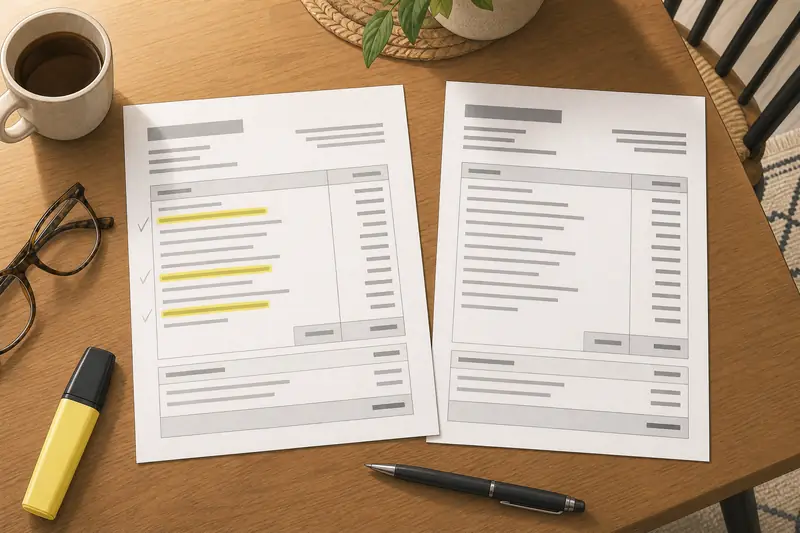
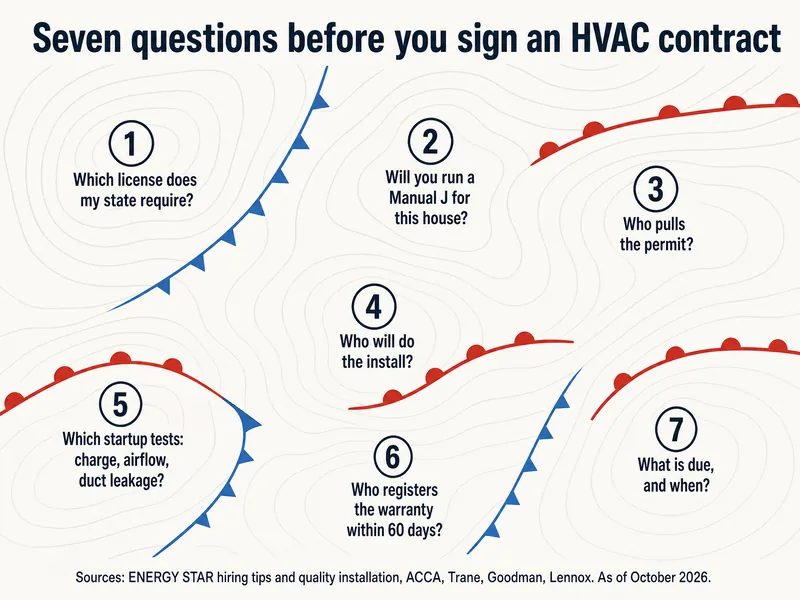
| Question | A complete answer | Source |
|---|---|---|
| Which license does my state require? | License type and number you can look up | ENERGY STAR hiring tips |
| Will you run a Manual J for this house? | Yes, with the report left with you | ACCA; ENERGY STAR bid checklist |
| Who pulls the permit? | The contractor, with named inspections | Local building office |
| Who does the install? | Crew or subcontractor, and who supervises | Your contract |
| Which startup tests will you record? | Charge, airflow, duct leakage, combustion check | ENERGY STAR quality installation |
| Who registers the warranty? | Named person, within 60 days | Trane, Goodman, Lennox |
| What is due, and when? | Deposit, progress and final payments by milestone | Written proposal |
What should they say about sizing?
A good answer is that they will calculate your home's heating and cooling loads with Manual J, pick equipment with Manual S and give you the numbers. ENERGY STAR's heat pump page says the contractor "should verify the proper size system for your home using a tool called 'Manual J'", and the International Residential Code (section M1401.3) calls for Manual S sizing from Manual J loads, with local adoption varying.
A weak answer is "same size as the old one" or a figure from floor area. Ask a follow-up: what load did the report show, in Btu/h, and how close is the selected unit to it? One ton is 12,000 Btu/h. If ducts are being changed, ask whether a Manual D duct design will set their sizes. The Manual J explainer shows what the report looks like.
Ask for
The load report
Heat loss and heat gain in Btu/h, the design temperatures used and the equipment capacity picked against them.
The matched pair
Outdoor and indoor model numbers with an AHRI reference; ENERGY STAR's checklist says the contractor should provide that certificate.
Who pulls the permit and who installs?
The contractor should pull the permit and name the inspections, and the quote should say whether its own crew or a subcontractor does the install. Rules differ by place: Wheeling, Illinois requires a building permit to replace a furnace or AC unit, with final mechanical and electrical inspections, while York County, Virginia needs no permit for a like-for-like electric condensing unit but does for any fuel-fired furnace. The permits and inspections page explains how to check yours.
On who installs, ask who will be on site, who supervises and who handles refrigerant. Only Section 608-certified technicians may buy refrigerant for home systems (EPA). ENERGY STAR also points to ACCA's list of contractors in its Quality Assured program as one place to look.
A service page shows what a company says it offers. As one example, Central Plumbing & HVAC, a plumbing and HVAC company in Pennsylvania, describes its heating service (Central Plumbing & HVAC, connected to the team behind The Second Bid) for Bucks and Montgomery County, mentioning NATE-certified technicians and combustion analysis; those are its own claims, it serves only that part of Pennsylvania, and it is not offered here as your best choice. Whoever you consider, ask them to show the license, certification or test their page names.
What tests happen at startup?
At startup, a quality installation tests and records the refrigerant charge, airflow and duct leakage for cooling and heat pump systems, and checks burner operation and venting for a furnace or boiler. ENERGY STAR's quality installation page asks you to make sure the contractor "tests and adjusts the system's refrigerant charge", sets airflow to the maker's specifications and runs a duct leakage test. ENERGY STAR's 2009 heating and cooling booklet adds: "Verify that your furnace or boiler has been tested for proper burner operation and proper venting of flue gases."
Ask for the readings on paper and for a walk-through of the filter and thermostat; ENERGY STAR's bid checklist asks contractors to show you how to replace the filter and to leave manuals and test records. For fuel-burning equipment, ask where the carbon monoxide alarms should go; the carbon monoxide safety page covers placement on every level and outside sleeping areas.
Which warranty questions matter?
Ask three things: how long the maker covers parts, how long the contractor covers labor, and who registers the equipment by when. Lennox says qualifying products registered within 60 days get five more years of parts coverage, ten in total. Goodman's 10-year parts term also needs registration within 60 days, except for residents of California, Florida, Georgia and Quebec. Trane's warranty covers parts, "not the labor".
So the labor answer has to come from the contractor, in years and in writing. Ask, too, what voids coverage: missed registration, unapproved parts or skipped maintenance. The warranty registration page covers the details, and what an HVAC quote should include shows how the warranty line should read.
How should payment be scheduled?
Payment should follow the work: a deposit at signing, any progress payment when equipment arrives or the old system comes out, and the final payment after startup tests and the permit inspection. ENERGY STAR advises signing a written proposal before work begins that specifies costs, model numbers, the job schedule and warranty information.
Ask how credits and rebates are handled in the total. The IRS ended 25C for equipment placed in service after 2025, so it shouldn't reduce a 2026 price (heat pump tax credit). State energy offices administer Home Energy Rebates; since DOE's Program Notice 26-2, heat pump rebates apply to replacing electric equipment or new construction (Home Energy Rebates in 2026). Then use the comparison worksheet to set the answers side by side.
Observation notes
Built from ENERGY STAR's hiring tips, quality installation page, duct sealing page, undated bid checklist and 2009 heating and cooling booklet; ACCA's Manual J page; IRC section M1401.3 (2015 text, as quoted by Texas's housing agency); EPA's refrigerant sales restriction; permit pages from Wheeling, Illinois and York County, Virginia; the warranty pages of Trane, Goodman and Lennox; the IRS 25C FAQ; and DOE Program Notice 26-2, read in October 2026. The Pennsylvania service pages are linked as one company's description of itself. Left out: contractor rankings, review scores and price ranges.
Outlook questions
How many contractors should I ask for quotes?
ENERGY STAR doesn't name a number; it says to compare proposals on cost, efficiency and warranties. Enough bids to see a pattern, with each one complete, matters more than the count.
Should I ask if the contractor is NATE-certified?
You can, as one signal of technician training, alongside your state's license requirement. Ask which technicians on your job hold it, not only whether the company does.
What should I ask about ductwork?
Ask whether the ducts will be inspected and leakage-tested, and what repairs are included. ENERGY STAR says a typical house loses about 20 to 30 percent of duct airflow to leaks.
Is it fair to ask for the Manual J report before signing?
Yes. The report is what the size and price rest on, and ENERGY STAR's checklist expects contractors to hand over their Manual J numbers.
Who should register the warranty, me or the contractor?
Either can, but agree on one person and a date inside the 60-day window. Ask for the confirmation, since Trane, Goodman and Lennox all tie the longer term to it.
What should I ask about refrigerant on a new system?
Ask which refrigerant the system uses and its manufacture date. Equipment built from 2025 on runs on R-454B, R-32 or another low-GWP refrigerant, while pre-2025 R-410A inventory remains legal to install after EPA's May 2026 rule.
Should I ask about carbon monoxide alarms when replacing a furnace?
Yes. CPSC's advice is a battery or battery-backup CO alarm on each floor plus one outside the sleeping areas, and a professional check of fuel-burning heating every year.
Further along the front