How to Compare HVAC Quotes Line by Line
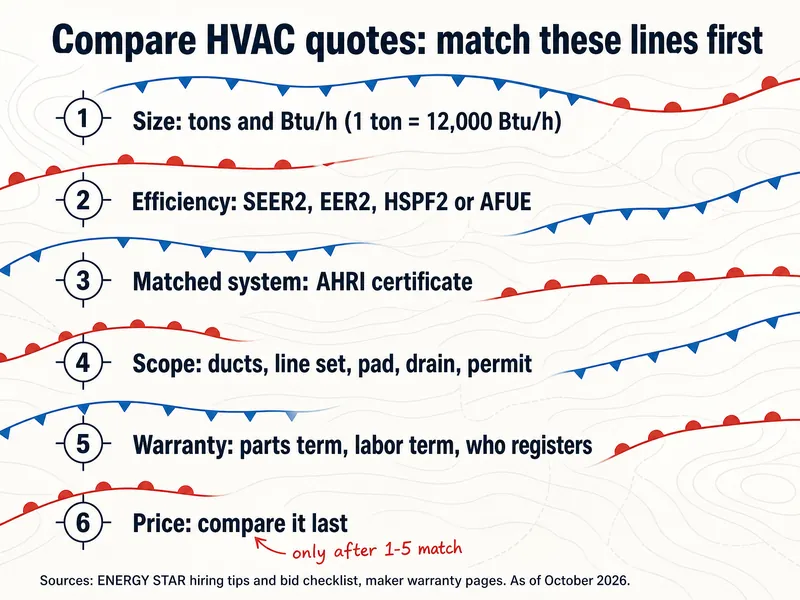
To compare HVAC quotes, first make the size, efficiency rating, installation scope, permit and warranty lines match, then compare price; ENERGY STAR says to weigh cost, efficiency and warranties together.
Read against its sources by The Second Bid · how pages are checked · Updated
Figures to line up across bids
- 12,000Btu/h in one ton of capacity, as worked in DOE's 2002 sizing sheetDOE/NREL 2002
- 14.3SEER2 floor for split heat pumps, with 7.5 HSPF210 CFR 430.32
- 30%efficiency that poor installation can cost, at mostENERGY STAR
- 60 daysregistration window for longer parts coverage at Trane, Goodman and LennoxTrane
How do you compare HVAC quotes fairly?
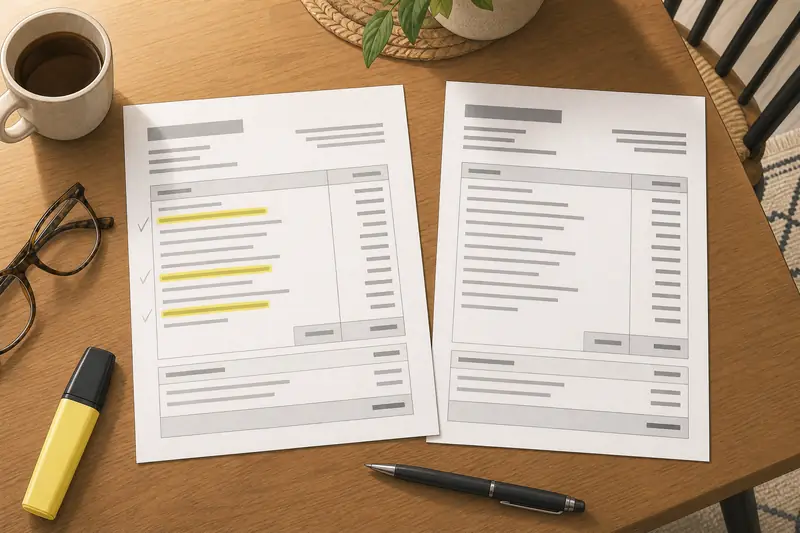
Put the bids side by side and match five lines before you look at any total: size, efficiency rating, proof the indoor and outdoor parts are a matched set, installation scope and warranty. Price only means something once those agree. ENERGY STAR publishes a Bid Comparison Checklist with three columns, A, B and C, and a yes-or-no question per row; it is undated but still linked from the agency's quality-installation page.
Build the same grid yourself: one row per line, one column per contractor. A blank cell is a question for that contractor, not a mark against them. ENERGY STAR doesn't set a number of bids to collect, so two careful ones can teach you more than five vague ones.
| Line | What to write in each bid's column | Where the answer comes from |
|---|---|---|
| Size | Cooling tons and Btu/h; heating output in Btu/h | Manual J load calculation |
| Efficiency | SEER2 and EER2; HSPF2 for a heat pump; AFUE for a furnace | AHRI certificate for the matched pair |
| Model numbers | Outdoor unit, indoor coil or air handler, furnace, thermostat | The written proposal |
| Ducts | Inspection, leakage test, repairs named or excluded | ENERGY STAR quality installation |
| Startup | Refrigerant charge and airflow tested and recorded | ENERGY STAR quality installation |
| Permit | Who files it and which inspections follow | Your city or county building office |
| Warranty | Parts years, labor years, who registers | Maker warranty page plus the contractor |
| Price | Total, deposit, payment dates | The written proposal |
Which lines must match before comparing price?
Size and efficiency must match first, because a larger or higher-rated system is a different purchase, not a pricier version of the same one. A 3-ton bid and a 3.5-ton bid differ by 6,000 Btu/h of cooling, and only a load calculation says which one the house needs. ENERGY STAR's heat pump page says the contractor "should verify the proper size system for your home using a tool called 'Manual J'".
If one bid names a size with nothing behind it, ask for the Manual J load calculation before you compare anything else. Then check the pairing: efficiency is rated for an outdoor unit and indoor coil together. The ENERGY STAR checklist says your contractor should provide an AHRI certificate "to document that your system was properly matched", and certified pairs can be looked up in the AHRI Certification Directory.
Line to look for
Size, with its source
An illustration of a clear line: "Manual J: cooling load 31,400 Btu/h, heating load 44,800 Btu/h. Selected: 3-ton heat pump, AHRI ref. no. listed."
Ratings for the pair
An illustration: "Outdoor model and indoor coil model as listed; matched rating 16.0 SEER2, 8.1 HSPF2."
How do you compare equipment in HVAC quotes?
Compare model numbers and the matched ratings, not brand names or series labels. Under 10 CFR 430.32, split heat pumps made from January 1, 2023 need 14.3 SEER2 and 7.5 HSPF2 everywhere. Split central air needs 13.4 SEER2 in the North; in the Southeast and Southwest it needs 14.3 SEER2 below 45,000 Btu/h and 13.8 at 45,000 and up, and the Southwest adds EER2 floors. The SEER2 regional minimums page has the full table.
Furnaces are compared by AFUE: 80% is the federal floor for non-weatherized gas furnaces today, and ENERGY STAR certifies gas furnaces at 97% or more in the North and 95% or more in the South. The AFUE comparison explains the 80% versus 95% choice. Never compare an old SEER figure with a SEER2 figure; DOE's 2017 test-procedure rule says the new metrics "generally have different numerical values", and there's no fixed conversion.
Refrigerant can split two bids as well. Equipment made or imported before January 1, 2025 with R-410A may still be installed under EPA's final rule of May 26, 2026, which is being challenged in court, while newer systems use R-454B or R-32. Ask each contractor which refrigerant and what manufacture date; the refrigerant change page explains why it matters.
How do you compare the installation scope?
Scope is where bids differ most, and it is where efficiency is won or lost. ENERGY STAR's quality installation page asks for three things: airflow that meets the maker's specifications, a refrigerant charge the contractor "tests and adjusts", and a duct inspection with a leakage test. In a typical house, about 20 to 30 percent of the air moving through ducts is lost to leaks and poor connections, according to ENERGY STAR's duct sealing page.
Then check the smaller lines: removal of the old equipment, a new or reused refrigerant line set, the pad, the condensate drain, the electrical disconnect and the thermostat. The ENERGY STAR checklist asks outright whether the contractor will install new refrigerant lines rather than reuse old ones. The installation extras page covers each of these, and Manual D duct design explains when ducts belong in the scope at all.
Ask for
A startup record
Written readings of refrigerant charge and airflow at startup; the ENERGY STAR checklist asks for "records of any measurements or testing".
The duct line in writing
Whether ducts will be inspected, leakage-tested and repaired, or are excluded from the job.
The permit line
Who files it and which inspections follow. Rules vary: Wheeling, Illinois requires a permit to replace a furnace or AC, while York County, Virginia exempts a like-for-like electric condensing unit but not a fuel-fired furnace.
What about warranties and labor coverage?
Treat the maker's parts warranty and the contractor's labor warranty as two separate lines in every bid. Trane says its registered warranty "in most cases" lasts 10 years if the product is registered within 60 days of installation, against five years for the base warranty, and both cover parts, "not the labor". Goodman gives a 5-year parts warranty without action and a 10-year term with online registration within 60 days; California, Florida, Georgia and Quebec residents don't need to register. Lennox adds five years beyond its basic term for products registered within 60 days.
So the comparison is: which maker term applies, who registers it and by when, and how many years of labor the contractor writes into the proposal. A bid that says "10-year warranty" without saying parts or labor hasn't answered the question. The warranty registration page covers the 60-day window in detail.
When is the cheapest quote the right one?
The cheapest quote is the right one when its size, ratings, scope, permit and warranty lines match the others. ENERGY STAR warns that "a lowest price may not be the best deal if it's not the most efficient because your energy costs will be higher." A low bid that skips the load calculation, the duct test or the permit is cheaper because it is a smaller job.
Check the money lines too. The IRS ended 25C for equipment put in service once 2025 closed, so a bid written this year that nets out a federal credit is wrong; details are on the heat pump tax credit page. Home Energy Rebates now run as state programs, and since DOE's Program Notice 26-2 (effective May 29, 2026) heat pump rebates cover replacing existing electric equipment, not a gas furnace swap; see Home Energy Rebates in 2026. If one bid still looks off after all that, read the HVAC quote red flags or get a second opinion on the quote.
Observation notes
This page reads ENERGY STAR's 10 tips for hiring a contractor, its quality installation and duct sealing pages and its undated Bid Comparison Checklist; ACCA's Manual J page; 10 CFR 430.32 for SEER2, HSPF2 and AFUE floors; DOE's 2017 SEER2 test-procedure rule; EPA's May 26, 2026 refrigerant rule; the IRS 25C pages; DOE Program Notice 26-2; and the Trane, Goodman and Lennox warranty pages, all read in October 2026. Two local permit pages are examples only. Left out: installed cost ranges (no primary source publishes them), contractor blog advice and forum anecdotes.
Outlook questions
Should both HVAC quotes use the same tonnage?
They should if both contractors ran a load calculation on the same house. If one says 3 tons and another 4, ask each for the Manual J numbers; a gap of 12,000 Btu/h is one whole ton and means someone guessed.
How do I compare a heat pump bid with a furnace and AC bid?
Line up what each system does in summer and winter: SEER2 and EER2 for cooling, HSPF2 for heat pump heating, AFUE for the furnace. Then compare fuel, backup heat and scope. The heat pump vs furnace page walks through that choice.
Is a higher SEER2 bid always worth the extra money?
Not always. The gain depends on how many hours the system runs, your electric rate and whether the ducts and charge are done right. ENERGY STAR puts poor installation losses at up to 30 percent, which can erase a rating gap.
What if one quote lists a model number and the other only a brand?
Ask the second contractor for the outdoor unit, indoor coil and furnace or air handler model numbers before you compare. ENERGY STAR says a signed written proposal should specify model numbers.
Does the cheaper quote reuse my old line set?
Look for a line set entry. The ENERGY STAR checklist asks whether the contractor will install new refrigerant lines rather than reuse existing ones, so a quote silent on it hasn't told you.
Can a 2026 quote include the federal heat pump tax credit?
No. The IRS stopped 25C at the end of 2025 for new installs. Rebates may exist through your state's energy office, with rules set by that program.
Do I need the same warranty length on every quote?
You need the same kind of information: maker parts years, contractor labor years and who registers. Many makers tie their longer parts term to registration within 60 days.
Further along the front
Back to The Second Bid front page