Repair or Replace Your HVAC System?
Repair or replace your HVAC system? Repair a sound system with a common, single-part fault; consider replacing when ENERGY STAR's triggers stack up, such as an AC over 10 years or a furnace over 15 with frequent repairs.
Read against its sources by The Second Bid · how pages are checked · Updated
Ties: Who is behind these links: The Second Bid is run by the same team that owns Plumbing Supply and More, SoftPro Water Systems and Quality Water Treatment, and that is connected to Central Plumbing & HVAC. No link here is paid placement. This page reads federal rules, ENERGY STAR and DOE criteria, ACCA's manuals and makers' own documents, checked in October 2026. Nothing was installed or measured by us; a linked business's description of its own goods is that business's claim. How these links work
Should you repair or replace your HVAC system?
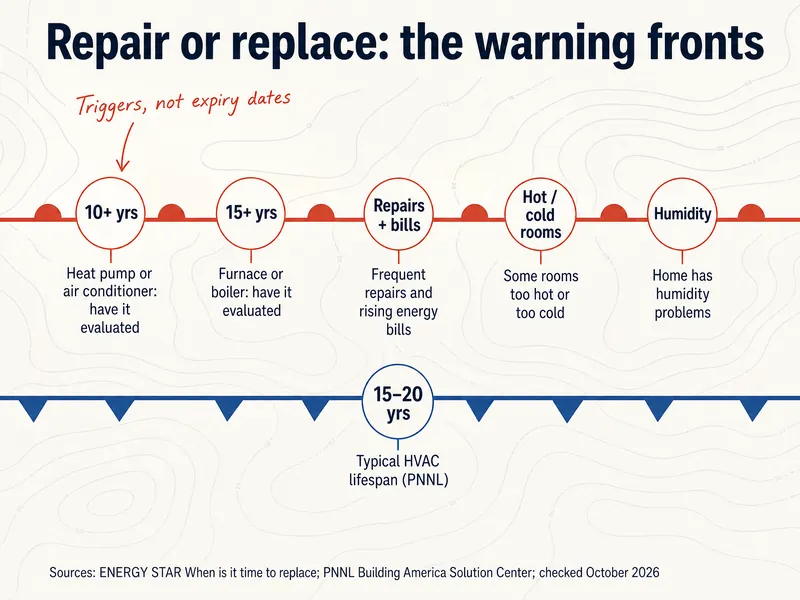
Repair when the system is mid-life, the fault is a common small part, and comfort was fine before it broke; replace when age, repeat repairs, rising bills and comfort problems arrive together. ENERGY STAR's replacement page lists the signals: equipment past 10 or 15 years, "frequent repairs and your energy bills are going up", rooms "too hot or too cold", and humidity problems. One signal on its own rarely settles it.
Two things push toward repair more than people expect. The 25C federal credit no longer offsets a 2026 replacement, and state heat pump rebates under DOE's renamed program now cover electric-to-electric upgrades but not a gas furnace swapped for a heat pump (see home energy rebates). A replacement has to stand on its own numbers.
How old is too old?
No age is too old by rule; ENERGY STAR's 10 and 15 years are the points to have a system evaluated, and PNNL's 15 to 20 years is a typical span, not a deadline. The PNNL figure, "The typical lifespan of HVAC equipment is 15 to 20 years", comes from DOE's Building America Solution Center and is one generic number, not split by equipment type.
| Signal | Leans repair | Leans replace | Source |
|---|---|---|---|
| Age, AC or heat pump | Under 10 years | Over 10 years plus other signals | ENERGY STAR |
| Age, furnace or boiler | Under 15 years | Over 15 years plus other signals | ENERGY STAR |
| Repair history | First failure of a small part | Frequent repairs, rising bills | ENERGY STAR |
| Refrigerant | R-410A system with a minor fault | Major failure on an older, mismatched system | EPA FAQ |
| Comfort | Rooms were even before the fault | Rooms too hot or cold, humidity problems | ENERGY STAR |
| Cracked heat exchanger | Not a repair to defer | Usually means a new furnace | Technician's written finding |
Age matters most when it meets a big failure. A compressor or heat exchanger on a 16-year-old system is a different decision from a capacitor on a 6-year-old one. Check the maker's warranty before paying for any part: Trane, Goodman and Lennox all extend parts coverage when the unit was registered within 60 days of install, and parts warranties generally exclude labor (warranty registration).
Replace triggers on the record
- 10 yearsAge at which ENERGY STAR suggests weighing AC or heat pump replacementENERGY STAR
- 15 yearsSame prompt for furnaces and boilersENERGY STAR
- 15–20 yearsTypical HVAC equipment lifespanPNNL Building America Solution Center
- up to 30%Possible efficiency loss from a poorly done installENERGY STAR
Which repairs are usually worth doing?
Repairs to small, common parts are usually worth doing on a system that is otherwise sound. In Carrier's own account of furnace parts, wear items such as igniters, flame sensors and capacitors tend to go well before the big components, which it puts at 15 to 20 years when maintained (Carrier). On the cooling side, Lennox says a failing capacitor "causes hard starts, humming, or no cooling" (Lennox).
Those parts are sold by the rating printed on them; a supply house's capacitor range (Plumbing Supply and More, run by the same team as The Second Bid) shows how they are listed, which helps you read a repair ticket. The work is not a homeowner job. Carrier warns that capacitors "store high-voltage electricity that can cause serious injury or death, even when the power is disconnected" (Carrier); leave capacitor and hard-start replacement to a licensed technician.
Your own checks stop at the filter, thermostat settings and batteries, and the breaker or outdoor disconnect: reset a tripped breaker once, and if it trips again, leave it off. If you're unsure, stop and call a licensed HVAC technician.
What does the refrigerant change mean for repairs?
The refrigerant change does not force replacement: EPA says an existing R-410A system can be repaired, including "replacing a major component like a condensing unit or compressor". New R-410A components made after January 1, 2025 must be labeled "for servicing existing equipment only". New systems made or imported since that date use refrigerants under 700 GWP, such as R-454B or R-32.
EPA's final rule of May 26, 2026 (effective July 27, 2026) also lets equipment made or imported before 2025 still be installed; the rule is being challenged in court (Federal Register). Only Section 608-certified technicians may buy refrigerant or open the circuit. The full timeline is on the refrigerant transition page.
Where refrigerant does tip the scale is a big failure on an old split system. ENERGY STAR's 2009 booklet warns that a new outdoor unit without a matched indoor coil "is likely to result in low efficiency, and may lead to premature failure" (PDF), so a compressor job on a tired system can grow into a near-replacement.
How do you test a replace verdict?
Test a replace verdict by asking for the failed part, the evidence and the repair price in writing, then comparing it with what a replacement would fix. A technician who says "it's time" should be able to name the failure and show it, such as a photo of a cracked heat exchanger or a compressor test result.
Before you agree to replace
Ask for
The diagnosis in writing: part name, test or reading, and the repair price, even if you plan to replace.
Ask for
The warranty status by serial number; a registered unit may have years of parts coverage left.
Line to look for
On the replacement quote, a written line such as: "Size per Manual J load calculation attached; matched indoor coil and outdoor unit, AHRI-rated combination."
Ask for
A second opinion before replacing a system under 10 years old for anything but a major failure.
If replacement wins, size it fresh. ENERGY STAR's air-source heat pump page says a contractor "should verify the proper size system for your home using a tool called 'Manual J'"; the old unit's tonnage is not a load calculation (what size AC do I need). ENERGY STAR adds that correctly installed certified units "can save up to 20 percent on heating and cooling costs".
What is the $5,000 rule?
The $5,000 rule is a contractor rule of thumb, not a guideline from any agency: multiply the system's age by the repair cost, and if the result is over $5,000, it says to lean toward replacement. A 12-year-old system with a $500 repair scores 6,000; a 5-year-old one with the same repair scores 2,500.
It is quick but blunt. It ignores warranty coverage, the system's efficiency, whether the repair fixes a root cause, and comfort problems a new system would or would not solve. Use it as a prompt to ask questions, alongside ENERGY STAR's signals, never as the verdict. For what else changes the price of a new system, see installation extras.
Observation notes
This page reads ENERGY STAR's replacement, installation and heat pump pages and 2009 heating and cooling booklet, PNNL's Building America Solution Center, EPA's HFC phasedown FAQ, the Federal Register rule of May 26, 2026, the IRS 25C FAQ, and Carrier and Lennox homeowner pages, reviewed in October 2026. Excluded: repair and replacement prices, which no primary source publishes, and any testing or replacement steps for electrical or refrigerant parts.
Outlook questions
Is it worth repairing a 15-year-old furnace?
It can be, for a small part such as an igniter or flame sensor on a furnace with a sound heat exchanger. ENERGY STAR treats 15 years as the point to have a contractor evaluate it, not as a deadline.
Should both the indoor and outdoor units be replaced together?
For a split AC or heat pump, usually yes. ENERGY STAR's 2009 booklet says a new outdoor unit with an old indoor coil is likely to run at low efficiency and may fail early.
Can my R-410A air conditioner still be fixed in 2026?
Yes. EPA says existing R-410A systems can be repaired, including a new condensing unit or compressor, and R-410A is not banned. Refrigerant work requires a Section 608-certified technician.
Does a cracked heat exchanger mean replacing the furnace?
Usually. A cracked heat exchanger can let combustion gases mix with house air, so it is not a repair to put off; ask for photos and the written finding, and keep CO alarms working on every level.
Is there a tax credit for replacing a system in 2026?
No federal one. The 25C credit stopped with property placed in service in 2025; state rebates may apply in some states under DOE's 2026 rules. See heat pump tax credit.
Does a home warranty change the repair-or-replace math?
It can lower a repair bill, but its terms are the provider's own. Read what it excludes and who chooses the technician before relying on it.
How long should a new system last?
PNNL gives 15 to 20 years as a typical lifespan for HVAC equipment. Care matters: Carrier ties the long life of major furnace parts to regular maintenance.
Further along the front