Folder · 4 pages
HVAC Rules: Efficiency, Refrigerant, Permits, Safety
HVAC rules for a replacement come from three levels: federal efficiency floors (SEER2, HSPF2, AFUE), EPA's refrigerant limits, and your city or county's permits, plus CO alarm advice from CPSC.
Read against its sources by The Second Bid · how pages are checked · Updated
Rules in numbers, October 2026
- 14.3SEER2 floor for split heat pumps nationwide, with 7.5 HSPF210 CFR 430.32
- 80%AFUE minimum for non-weatherized gas furnaces made before Dec 18, 202810 CFR 430.32
- 700GWP limit for new residential AC and heat pump systemsEPA
- 2030compliance date gas groups asked DOE to move the 95% furnace rule to, at a minimumFederal Register, Apr 27, 2026
Which HVAC rules apply when you replace a system?
Four sets of rules touch a typical replacement: DOE efficiency standards for the equipment, EPA refrigerant rules, local building codes and permits, and safety guidance on carbon monoxide. The first two are federal and the same everywhere except for the regional AC floors; the third changes at the county line.
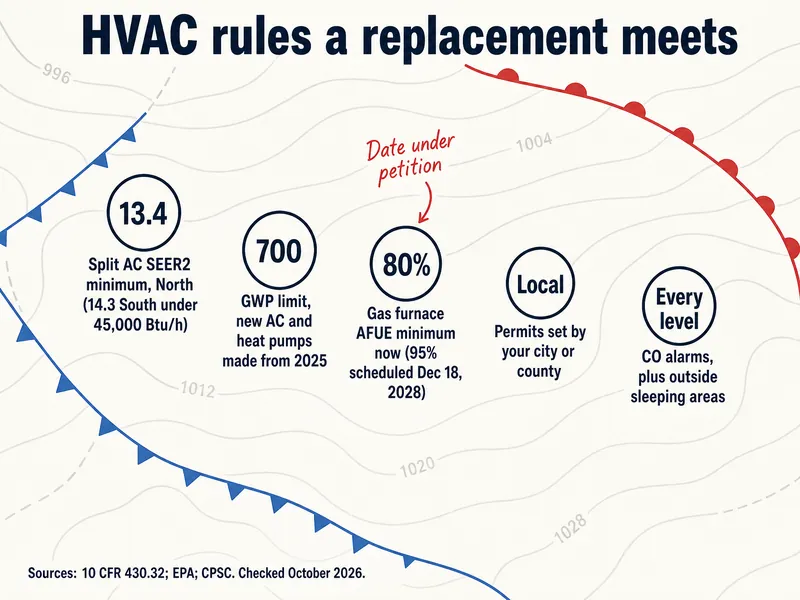
DOE's furnace floor is the one most likely to move. The CFR lists 80% AFUE for non-weatherized gas furnaces made before December 18, 2028 and 95% from that date, but gas industry groups asked DOE to push it "until January 1, 2030, at a minimum," and DOE published the petition for comment on April 27, 2026. Treat 2028 as scheduled, under petition and subject to change; furnace AFUE ratings has the detail.
| Rule | Who sets it | Who must meet it | Where this site covers it |
|---|---|---|---|
| SEER2, EER2 and HSPF2 minimums | DOE (10 CFR 430.32) | Makers; installers for regional AC floors | SEER2 minimums by region |
| Furnace AFUE minimum | DOE (10 CFR 430.32) | Makers, by manufacture date | Furnace AFUE ratings |
| Refrigerant GWP limit and Section 608 | EPA | Makers, importers, installers, technicians | The refrigerant change |
| Mechanical permits and inspections | City or county | Installer or permit holder | HVAC permits and inspections |
| CO alarm placement and yearly service | CPSC and CDC guidance, local code | Homeowners | Carbon monoxide safety |
What are the SEER2 minimums?
Split AC needs 13.4 SEER2 in the North; the Southeast and Southwest raise that to 14.3 for units below 45,000 Btu/h (13.8 for larger ones). Every split heat pump, in every state, needs 14.3 SEER2 and 7.5 HSPF2, and only Arizona, California, Nevada and New Mexico add EER2 floors. Equipment rated under a region's floor may not be installed there, which puts the regional rule on the installer.
What changed with refrigerants?
Any home AC or heat pump system manufactured or imported after 2024 uses a refrigerant under 700 GWP, mainly R-454B or R-32, both lower-flammability A2L refrigerants. EPA's May 26, 2026 final rule, effective July 27, 2026, lets equipment made before 2025 with R-410A still be installed; the rule is being challenged in court. R-410A is not banned, and EPA says existing systems can be repaired, including "replacing a major component like a condensing unit or compressor."
Only Section 608-certified technicians may buy refrigerant for home systems or work on the refrigerant circuit, per EPA's sales restriction.
Do you need a permit?
Usually, but your city or county decides. The Village of Wheeling, Illinois requires a permit for any residential furnace or AC replacement, with final mechanical and electrical inspections; York County, Virginia skips the permit when an electric outdoor unit or air handler is swapped like for like, but not for a fuel-fired furnace. The International Residential Code, section M1401.3, also calls for equipment sized with ACCA Manual S from Manual J loads, where adopted.
How do you stay safe from carbon monoxide?
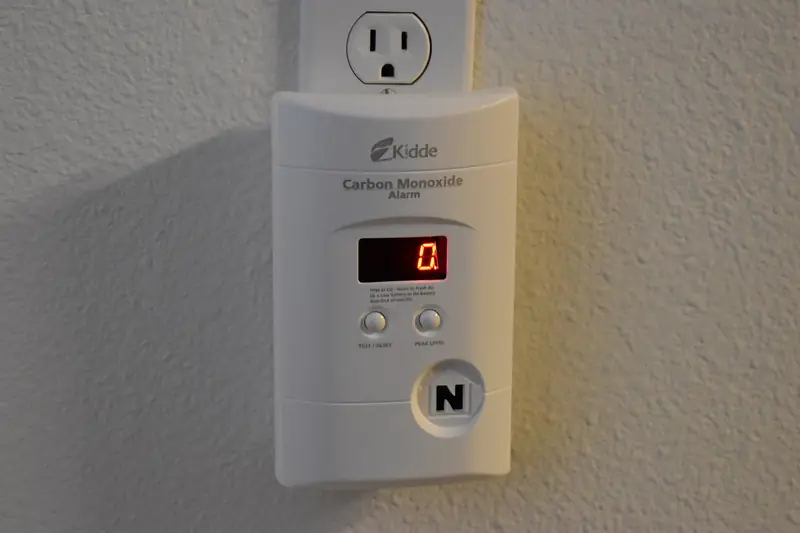
Carbon monoxide safety rests on two habits: alarms on each level of the house and outside sleeping areas, and a yearly professional inspection and service of fuel-burning heating. CPSC asks for "battery-operated CO alarms or CO alarms with battery backup," placed away from heating vents. When an alarm sounds or someone feels ill, move everyone into fresh air outdoors first, then phone 911 or the fire department. A gas smell means leaving the house and calling 911 or the gas utility's emergency number once outside.
Observation notes
This hub reads 10 CFR 430.32 (eCFR, current text), DOE's April 27, 2026 petition notice in the Federal Register, EPA's Technology Transitions sector table and May 26, 2026 final rule, EPA's Section 608 sales restriction page, local permit pages from Wheeling (IL) and York County (VA), and CPSC's carbon monoxide page, each read on October 27, 2026. Not covered here: state energy codes and local amendments (too varied to summarize), install cost ranges, and court outcomes not yet decided.
Outlook questions
Do federal efficiency rules apply to a repair?
The SEER2 and AFUE floors are written for equipment as manufactured and, for the regional AC floors, as installed. If a repair includes a new outdoor unit, ask the installer how the new combination is rated.
Could the 2028 furnace date still move?
No. As of October 2026 the CFR still lists 95% AFUE for non-weatherized gas furnaces made on or after December 18, 2028; a petition to delay it to 2030 or later is open.
Which rule is most likely to change next?
The furnace compliance date is under petition, and EPA's 2026 refrigerant rule is being challenged in the D.C. Circuit. Check the date on any page that cites either.
Does a heat pump have a regional efficiency rule?
No. The split heat pump floor is the same in every state; only central air conditioners get regional numbers.
Where do CO alarms go?
CPSC says each level of the home plus outside sleeping areas, kept away from heating vents and places furniture or drapes could cover them.
Can a homeowner skip the permit on a like-for-like swap?
Only where the local rule says so, as York County does for some electric equipment. Ask your building department before work starts.
Back to The Second Bid front page