HVAC Installation Extras That Move the Price
HVAC installation extras are the items beyond the equipment itself (line set, pad, condensate pump, thermostat, disconnect, permit and haul-away), and each should appear as its own named line on the quote.
Read against its sources by The Second Bid · how pages are checked · Updated
Ties: Who is behind these links: The Second Bid is run by the same team that owns Plumbing Supply and More, SoftPro Water Systems and Quality Water Treatment, and that is connected to Central Plumbing & HVAC. No link here is paid placement. This page reads federal rules, ENERGY STAR and DOE criteria, ACCA's manuals and makers' own documents, checked in October 2026. Nothing was installed or measured by us; a linked business's description of its own goods is that business's claim. How these links work
Which HVAC installation extras appear on quotes?
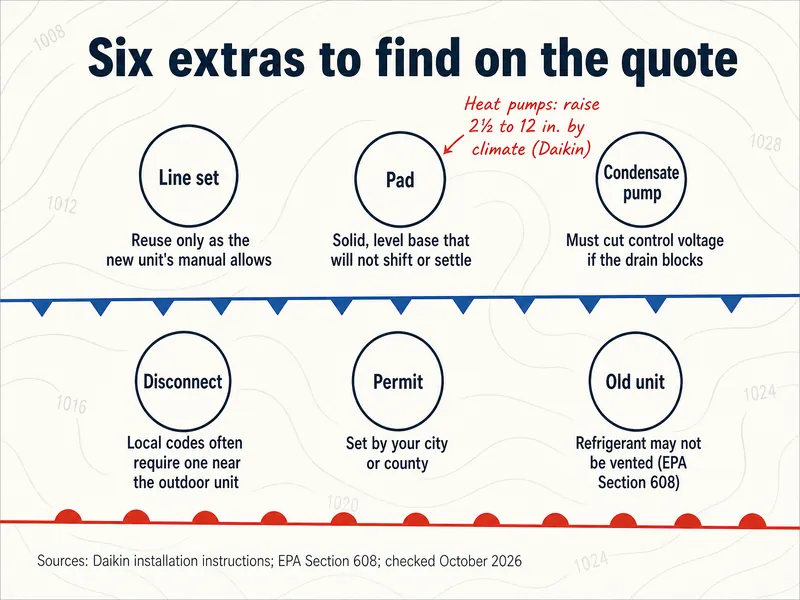
The HVAC installation extras that appear on most replacement quotes are the line set, the outdoor pad, condensate drainage, the thermostat, electrical work, the permit and haul-away of the old equipment. Each is real work with real parts; the question is whether the quote names it, says why it is needed, and shows it separately from the equipment.
ENERGY STAR's hiring tips ask you to "sign a written proposal with a contractor before work gets started" and to compare bids on "cost, energy efficiency and warranties". A bid that lumps every extra into one price is hard to compare with one that itemizes; the quote checklist covers the rest of the page.
| Extra | When it is needed | Where the rule comes from | Line to look for |
|---|---|---|---|
| Line set | New run, wrong size, damaged, or the new unit's manual says replace | Maker's installation manual | Size, length, and flush or replace method |
| Outdoor pad | Ground-level unit; raised base in snow country for heat pumps | Daikin installation instructions | Pad type and height |
| Condensate pump | No gravity drain from the coil or furnace | Daikin air handler instructions | Pump with overflow shutoff |
| Thermostat | Old one incompatible, or a heat pump needs a matched control | ENERGY STAR; DOE 2022 booklet | Model and who sets it up |
| Disconnect and wiring | New circuit, wrong breaker size, or no disconnect at the unit | Local code; Daikin manual | Breaker size and disconnect |
| Permit | Set by your city or county | Local building department | Permit fee and inspection |
| Haul-away | Removing old equipment | EPA Section 608 | Refrigerant recovery stated |
Should the line set be replaced?
The line set should be replaced when the new equipment's installation manual calls for it, when it is the wrong size for the new unit, or when it is damaged; otherwise many manuals allow reuse after cleaning. Lennox describes the larger insulated suction line and the smaller liquid line on its refrigerant lines page. Daikin's instructions for its DZ4SEA R-410A heat pump size both lines by tonnage and by run length, with separate columns for 0–24, 25–49 and 50–79 feet (Daikin).
The same Daikin manual has an "Existing line sets" section: drain residual compressor oil, use an approved flushing agent, then purge with nitrogen. It recommends replacing the indoor coil and says that when changing refrigerant types, the existing coil and metering device must be compatible with the new refrigerant. With new systems moving to R-454B and R-32 (see the refrigerant transition), ask the installer which page of the new unit's manual allows the old lines.
Line sets are sold by diameter and length, as a supply house's line set range (Plumbing Supply and More, run by the same team as The Second Bid) shows, which helps you check a quoted size. Brazing, pressure testing and evacuation are Section 608-certified technician work; a homeowner never opens or charges the circuit.
What are condenser pads for?
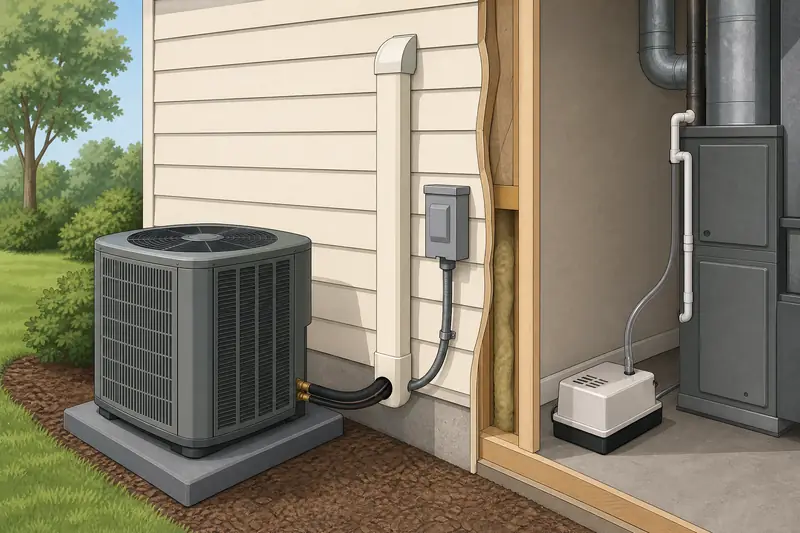
Condenser pads give the outdoor unit a stable, level base above the soil. Daikin's instructions say a ground-level unit "must be on a solid, level foundation that will not shift or settle", that the slab should not touch the house foundation to limit sound transmission, and that "a concrete slab raised above ground level provides a suitable base" (Daikin).
Heat pumps need more height in cold climates because they shed defrost water. Daikin's DZ5SE instructions recommend minimum elevations of 2½ inches where the design temperature is +15°F and above, 8 inches from −5°F to +14°F, and 12 inches below −5°F (Daikin). A flat pad on the ground under a new heat pump in a snowy state is worth a question.
Installation numbers from the manuals
- 12 in.Suggested minimum heat pump elevation below −5°F design temperatureDaikin installation instructions
- 2½ in.Suggested minimum heat pump elevation at +15°F design and aboveDaikin installation instructions
- 20–30%Share of duct air lost in a typical houseENERGY STAR
- up to 30%Efficiency lost to improper installationENERGY STAR
When is a condensate pump needed?
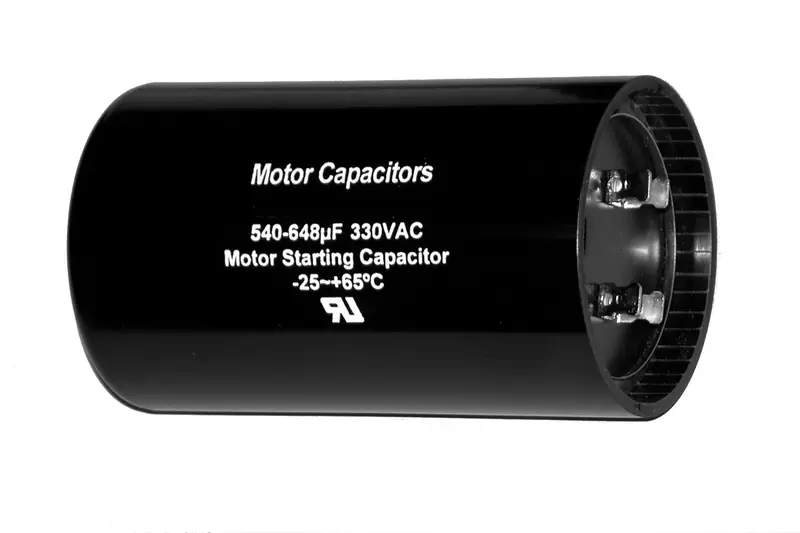
A condensate pump is needed when the indoor coil or a condensing furnace sits where water cannot drain by gravity, such as a basement with no floor drain nearby. Daikin's air handler instructions say: "Use of a condensate removal pump is permitted when necessary. This condensate pump should have provisions for shutting off the control voltage should a blocked drain occur. A trap must be installed between the unit and the condensate pump" (Daikin).
Placement raises the stakes. Another Daikin air handler manual calls an auxiliary drain pan "MANDATORY" where units sit above ceilings or wherever overflow could cause damage (Daikin). ENERGY STAR warns that "a plugged drain can cause water damage in the house" (maintenance checklist). Flushing the condensate line with plain water at its cleanout is a homeowner task; a pump that hums but doesn't empty, or water in the pan, is not. If you're unsure, stop and call a licensed HVAC technician.
Is a new thermostat included?
A new thermostat is included only if the quote says so, and it matters most when the new system is a heat pump or has two stages. ENERGY STAR's 2009 quality-installation checklist has the contractor "install and set up a programmable thermostat (if not already in use)" (ENERGY STAR booklet). DOE's 2022 booklet adds that heat pump owners shouldn't set back the heat without "a smart or programmable thermostat designed for use with heat pumps" (DOE).
A supply house's thermostat range (Plumbing Supply and More, run by the same team as The Second Bid) shows how many control types exist, which is why the quote should name the model. Ask whether the installer sets the heat pump's backup-heat lockout, and see dual-fuel heat pumps if a furnace stays in the system.
Which extras are fair and which are padding?
An extra is fair when a manual, a code or your house calls for it and the quote says which; it looks like padding when it is vague, duplicated, or not tied to anything. Electrical work is a good test: Daikin's manual notes that "local codes often require a disconnect switch located near the unit", so a new disconnect on a quote is reasonable when the old one is missing or worn.
Permits are another. Wheeling, Illinois asks for a building permit whenever a home furnace or air conditioner is replaced or altered (Wheeling), while York County, Virginia does not require one for a like-for-like electric condensing unit (York County). Check your own rules on permits and inspections.
Reading the extras
Line to look for
Written well, an extras block reads like: "Reuse existing 3/8 x 3/4 line set per manufacturer's existing-line-set procedure (flush, nitrogen purge, pressure test); new 4-inch composite pad raised on risers; new 60A fused disconnect; permit and final inspection; recover refrigerant and haul away old equipment."
Ask for
The manual page behind any line set or coil replacement, and the reason in one sentence.
Watch for
"Misc. materials", "system upgrade" or "labor adjustment" with no description, or the same item priced twice.
Ask for
Proof of refrigerant recovery on the old unit; EPA Section 608 prohibits venting refrigerant during disposal.
If extras turn a repair into a near-replacement, repair or replace walks through the trade-off, and how to compare HVAC quotes lines bids up item by item.
Observation notes
This page reads Daikin installation instructions for the DZ4SEA and DZ5SE heat pumps and two air handlers, Lennox's refrigerant lines glossary, ENERGY STAR's hiring tips, maintenance checklist, duct sealing page and 2009 heating and cooling booklet, DOE's 2022 Energy Saver booklet, EPA's Section 608 page, and Wheeling and York County permit pages, all opened in October 2026. Out of scope: prices for any extra, brazing or charging steps, and electrical sizing beyond what the manuals state.
Outlook questions
Can a new R-454B unit use my old R-410A line set?
Sometimes. Whether the lines can stay is decided by the new unit's installation manual, which may require flushing, a nitrogen purge, a pressure test, or new lines; ask the installer to show that page.
Why is the condensate pump on my quote?
Because the coil or condensing furnace can't drain by gravity where it sits. Daikin's instructions call for a pump that shuts off the system's control voltage if the drain blocks, with a trap between unit and pump.
Do I need a new pad for a new outdoor unit?
Not always. If the old pad is level, sound and the right size, it may stay; heat pumps in cold climates may need a raised base, per Daikin's elevation table.
Is a new outdoor disconnect a real requirement?
Often. Daikin notes that local codes often require a disconnect near the unit; a worn or missing one is a fair line item, sized to the new unit's nameplate.
Who pulls the permit, me or the contractor?
Usually the licensed contractor, but rules vary by city and county. Ask for the permit number and keep the final inspection record with the warranty papers.
Does haul-away of the old unit cost extra?
Some bids include it and some list it separately. Either way, the old unit's refrigerant must be recovered by a certified technician, not vented.
Is duct sealing an installation extra?
It can be, and it may matter more than the equipment: ENERGY STAR says typical duct systems lose about 20 to 30 percent of their air. See Manual D duct design.
Further along the front