The Refrigerant Change: R-410A to R-454B and R-32
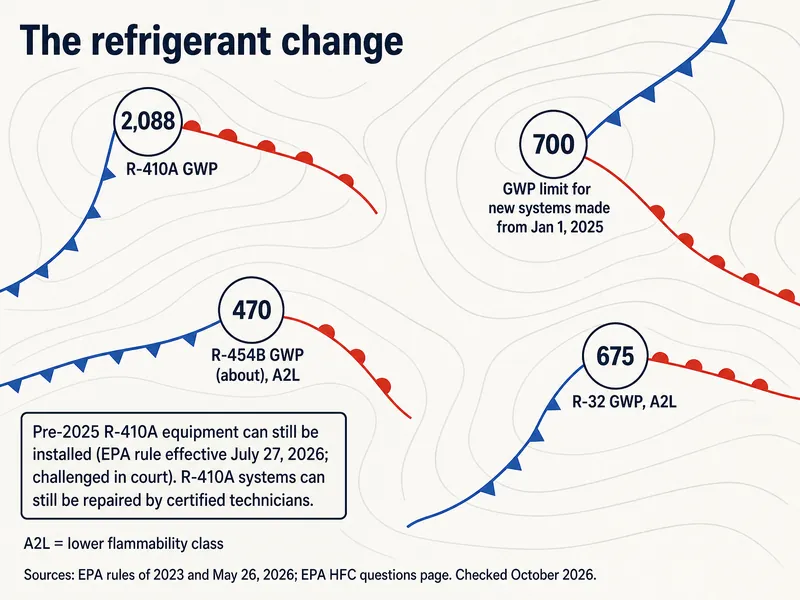
The refrigerant change means new home AC and heat pump systems made or imported from January 1, 2025 use a refrigerant under 700 GWP, usually R-454B or R-32, while R-410A systems stay repairable.
Read against its sources by The Second Bid · how pages are checked · Updated
The numbers behind the change
- 700GWP limit for new residential AC and heat pump systemsEPA
- 2,088GWP of R-410AEPA 2023 Technology Transitions rule
- 675GWP of R-32 (HFC-32)EPA 2023 SNAP rule
- 85%HFC phasedown from historic baseline by 2036 under the AIM ActEPA
What is the refrigerant change?
The refrigerant change is EPA's move, under the 2020 AIM Act, away from high-GWP HFC refrigerants such as R-410A in new home AC and heat pump systems. EPA's questions page says the act "mandates the phasedown of HFCs by 85 percent from historic baseline levels by 2036."
For split systems, mini-splits and packaged units, the limit is 700 GWP with a "January 1, 2025" manufacture and import date. EPA's sector table now adds: "No installation compliance date for systems where all specified components were manufactured or imported prior to January 1, 2025." That last line is the 2026 change.
The original 2023 rule had also set a January 1, 2026 deadline to install systems built from older R-410A parts. EPA's final rule of May 26, 2026 removed it, stating that pre-2025 inventory may "continue to be installed." Some pages, including parts of EPA's own questions page, still repeat the 2026 deadline; the final rule governs. A petition for review was filed in the D.C. Circuit in July 2026, so watch for changes.
What are R-454B and R-32?
R-454B and R-32 are the two main replacements makers adopted for home systems; EPA's 2026 rule notes "substitutes, including R-454B and R-32, were being developed and deployed." R-32 is a single HFC (HFC-32) with a GWP of 675. R-454B is a refrigerant blend; EPA's 2023 SNAP rule puts its weighted GWP at about 470.
The two are not interchangeable with each other or with R-410A. A system is designed, tested and labeled for one refrigerant, and its coil, metering device and controls are matched to it. That is why a new outdoor unit usually means a new matched indoor coil, which what an HVAC quote should include asks you to check.
| Refrigerant | GWP | A2L (lower flammability)? | Status for new systems |
|---|---|---|---|
| R-410A | 2,088 | No | Over 700; only pre-2025 equipment may still be installed |
| R-32 (HFC-32) | 675 | A2L | Under 700; used in new systems |
| R-454B | About 470 | A2L | Under 700; used in new systems |
| R-22 | Ozone-depleting, not rated here | No | Phased out earlier; existing systems only |
What does A2L mean?
A2L is an ASHRAE safety class meaning lower toxicity (A) and lower flammability (2L). EPA's SNAP rule explains that 2L refrigerants show flame propagation but have a heat of combustion under 19,000 kJ/kg and "a maximum burning velocity of 10 cm/s or lower," and it calls HFC-32 and the R-454 blends "lower flammability refrigerants... with an ASHRAE safety classification of A2L."
In practice, A2L refrigerants are listed by EPA as acceptable "subject to use conditions" (SNAP Rule 25 covers residential and light commercial AC and heat pumps), which include safety standards and warning labels on the equipment. Local building codes adopt those rules on their own schedule, so the installer should know what your jurisdiction requires. EPA also warns that flammable or mildly flammable refrigerants "such as HFC-32 or R-454B" can't go into "systems that were not designed to use them," so A2L is never a drop-in top-off for an R-410A system.
Can R-410A systems still be repaired?
Yes. EPA's answer is direct: "you can continue to repair your existing refrigeration, air conditioning, and heat pump system. This includes replacing a major component like a condensing unit or compressor." New R-410A components made after January 1, 2025 must be labeled "for servicing existing equipment only."
R-410A is not banned, and you don't have to replace a working R-410A system. EPA does caution that "the availability of HFCs and components may lessen over time as HFCs are phased down," which can affect repair choices on an older system; repair or replace walks through that decision. If a leak keeps coming back, ask for the leak to be found and fixed rather than repeated recharges. If you're unsure, stop and call a licensed HVAC technician.
Can homeowners buy or add refrigerant?
No. EPA's sales restriction limits refrigerant for stationary AC and heat pumps to buyers holding Section 608 certification (and their employers), and its Section 608 rules prohibit "intentionally venting" refrigerants and HFC substitutes during service or disposal. Opening the refrigerant circuit, recovering or adding charge is work for a certified technician.
Two details often confuse people. The sales restriction "does not cover refrigeration and air-conditioning equipment or components containing refrigerants," which is why pre-charged equipment falls outside the sales limit; connecting it still involves the refrigerant circuit, which this site leaves to a certified technician. And EPA "does not issue certification cards"; certifying organizations do, so ask to see the technician's card from one of them.
What should a quote say about refrigerant?
A quote for new equipment should name the refrigerant, and the outdoor unit, coil and air handler or furnace should be a matched set for it. For an R-410A system offered in 2026, ask for the manufacture date: only equipment whose components were made or imported before January 1, 2025 may be installed.
For repairs, the quote should list the refrigerant type, the amount added and whether a leak search was done. On a new install, ENERGY STAR says to make sure your contractor "tests and adjusts the system's refrigerant charge" (ENERGY STAR quality installation). Questions to ask an HVAC contractor has more wording.
Line to look for
New system
An example line such as "R-454B matched system: outdoor model, indoor coil model, air handler model; charge verified per manufacturer at start-up" covers refrigerant, match and commissioning.
R-410A offered in 2026
An example line such as "R-410A condenser, manufactured 11/2024, from pre-2025 inventory" answers the date question before you ask it.
Ask for
The technician's Section 608 certification, the refrigerant type on every repair invoice, and the leak location if charge was added.
Observation notes
This page reads EPA's Technology Transitions sector table (updated August 2026), EPA's HFC phasedown questions page (updated September 2026), EPA's May 26, 2026 reconsideration final rule, EPA's October 2023 Technology Transitions rule and April 2023 SNAP rule, EPA's Section 608 pages and ENERGY STAR's quality installation page, all read October 27, 2026. Left out: refrigerant prices and repair cost ranges (no primary source), DIY charging steps (certified work only), and court outcomes not yet decided.
Outlook questions
Was January 1, 2026 the last day to install an R-410A system?
Not any more. EPA's final rule effective July 27, 2026 removed that installation deadline for systems built from components made or imported before January 1, 2025.
Can an R-410A system be converted to R-454B?
EPA says mildly flammable refrigerants such as R-454B can't be used in systems not designed for them, so a conversion is a replacement of the matched equipment, not a refrigerant swap.
Can a new R-454B outdoor unit be paired with an old R-410A coil?
A system is rated and listed as a matched set for one refrigerant. Ask the installer for the maker's approved indoor match and the AHRI certificate for the combination.
Will R-410A disappear for repairs?
EPA says repairs can continue for the system's useful life, but HFC and component availability "may lessen over time" as the phasedown proceeds.
Is R-454B dangerous in a house?
EPA lists it as lower flammability (A2L) and allows it in new home systems under design rules, labels and installation standards. Follow the maker's install manual and local code.
Can a homeowner buy a can of R-410A to top off an AC?
No. EPA limits sales of refrigerant for stationary AC and heat pumps to Section 608-certified technicians and their employers.
What about an R-22 system?
EPA says an R-22 indoor coil isn't compatible with an R-410A outdoor unit because of different pressures, so an R-22 system generally needs a matched replacement.
Further along the front
Back to The Second Bid front page