Cold Climate Heat Pump Sizing
A cold climate heat pump is sized to your home's heating load at the local design temperature, using the unit's tested output at that temperature, not the nameplate tonnage or the cooling load.
Read against its sources by The Second Bid · how pages are checked · Updated
What makes a cold climate heat pump different?
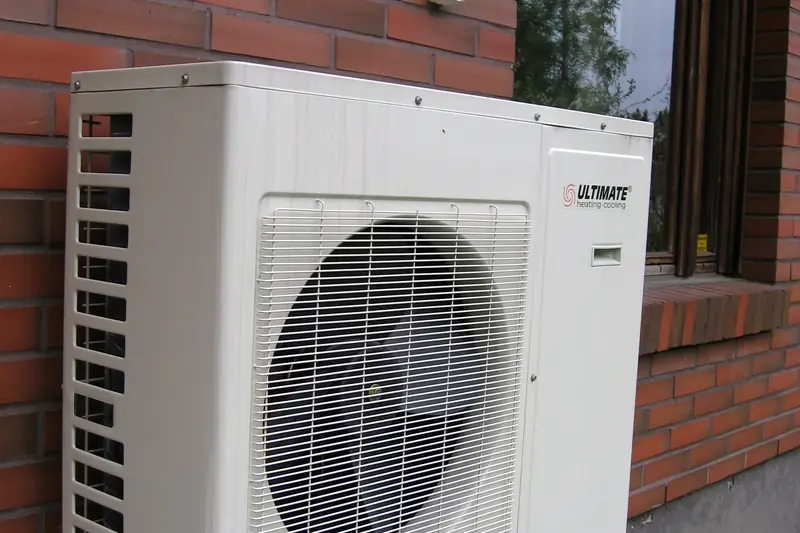
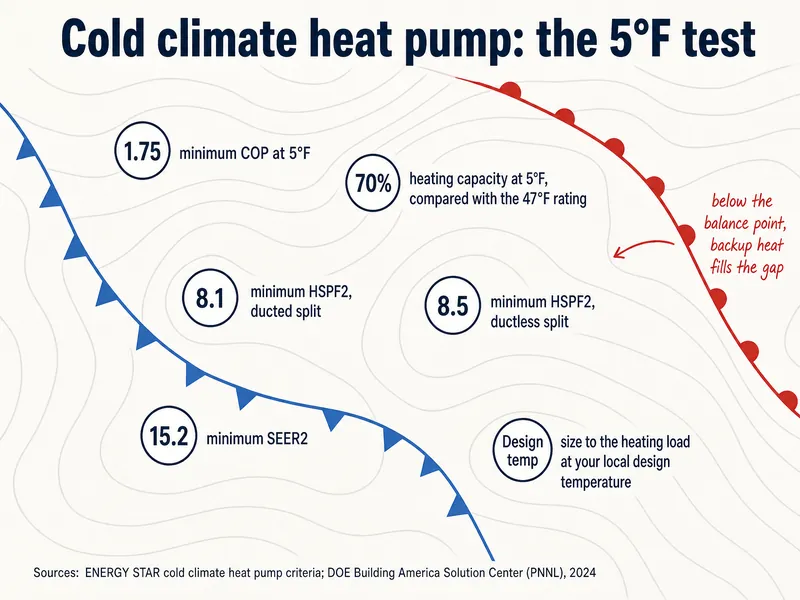
A cold climate heat pump keeps most of its heating output and a useful efficiency when the outdoor air drops to 5°F, and ENERGY STAR tests that directly. Its cold climate criteria require a coefficient of performance (COP) of at least 1.75 at 5°F, capacity at 5°F of at least 70% of the unit's 47°F rating, and a controls verification procedure.
Standard heat pumps lose ground sooner. PNNL's page on traditional split heat pumps, last updated in 2017, says their heating efficiency drops when outside temperatures fall below about 35°F, so a backup heat source is often needed. A COP of 1.75 still means 1.75 units of heat delivered for each unit of electricity at 5°F, which is why the test point matters more than the name on the box.
ENERGY STAR's own consumer page adds that a cold climate unit "will continue working at temperatures below 5°F," and that pairing it with a backup source heats most efficiently when it is colder still (air-source heat pumps).
How is a cold climate heat pump sized?
Sizing starts with a Manual J load calculation for heating and cooling, then picks the heat pump whose output at your design temperature meets the heating load you want it to carry. PNNL's cold-climate sizing page (updated May 2024) sets out four approaches, from cooling-first to all-electric heat:
| Approach | What the heat pump is for | How it is sized |
|---|---|---|
| 1. Cooling first | Mainly air conditioning | To the design cooling load; a cold-climate model isn't required |
| 2. Cooling plus some heat | Cooling, with as much heat as practical | The design cooling load sits at the mid or low end of the unit's range |
| 3. Heat with backup | Main heat, with a backup system carrying the cold end | Somewhat undersized for heating, usually a cold-climate model |
| 4. All or nearly all heat | The home's heat source | To the design heating load at the design temperature, with a cold-climate model |
PNNL adds that when the Manual J process is followed, "additional upsizing or rounding up is not needed" and can lead to oversizing. The design temperature is a local weather figure, so the same house needs a different unit in Minneapolis than in Philadelphia.
Ask for: "the Manual J heating and cooling loads, the design temperature used, and the selected model's heating output at that temperature from the maker's extended performance table."
What do the 5°F figures mean?
The 5°F figures say how much heat the unit still delivers, and how efficiently, on a cold night. The 70% capacity rule means a unit rated for 36,000 Btu/h at 47°F must still deliver at least 25,200 Btu/h at 5°F to carry the label; the COP rule means it delivers at least 1.75 times the heat energy of the electricity it uses at that point.
Cold climate figures with a source
- 1.75lowest COP allowed at 5°F under the ENERGY STAR cold climate labelENERGY STAR
- 70%minimum heating capacity at 5°F compared with the 47°F ratingENERGY STAR
- 8.1 / 8.5minimum HSPF2, ducted / ductless cold climate split systemsENERGY STAR
- Zone 4+IECC climate zones the NEEP cold-climate specification targetsNEEP
Read the table the right way round. Nameplate tonnage is a cooling figure at mild test conditions; PNNL says "the capacity at design conditions must be determined." If your design temperature is below 5°F, the maker's extended data at that temperature is the number to compare with your heating load.
How do you use the NEEP list?
NEEP's cold climate air-source heat pump list is a searchable table of models with performance at several outdoor temperatures, built for programs in IECC climate zone 4 and colder. NEEP says listing makes "standardized cold-climate performance data available to contractors, designers, consumers, utilities, and program administrators" (NEEP specification); the list itself is at ashp.neep.org.
Use it to check the quoted outdoor and indoor model numbers as a matched pair and read the maximum heating output at 5°F and at the lowest temperature listed. Two cautions from the list's own notes: after its April move to AHRI data reporting, some eligible products had not yet been reported, so a missing model is not proof it fails. NEEP wrote the specification as a model "minimum requirement for program qualification" for efficiency programs, so check whether your state or utility program requires a listed model before signing.
What is backup heat for?
Backup heat covers the hours below the balance point, the outdoor temperature at which the heat pump's output equals the home's heat loss. PNNL says below that point "the heat pump cannot fully meet the home's heating needs without a backup heat source," and that controls should let the backup run only below the balance point (commissioning page).
Backup can be electric strip heat in the air handler or a gas furnace in a dual fuel heat pump setup. Thermostat habits matter: large manual setbacks can call for costly strip heat on recovery, so use a heat-pump-rated thermostat (DOE) or keep a steady setting (ENERGY STAR). A quote should state the strip heater's size in kW and the outdoor temperature below which it is allowed to run.
Line to look for: wording along the lines of "Auxiliary heat locked out above the balance point; lockout temperature set at commissioning and recorded."
Should heating or cooling decide the size?
In cold climates, heating usually decides the size, because the heating load is larger than the cooling load and sizing to cooling leaves the house short of heat. That is the trade the PNNL approaches make explicit: size to cooling and accept more backup heat, or size to heating with a variable-capacity unit that can turn down in summer.
ACCA's Manual S, 3rd edition, added "expanded size tolerances for variable capacity heat pumps" that "allow for heating sizing" (Manual S). A single-speed unit sized to a large heating load can run short cycles in summer and remove less moisture; see oversized AC problems. For the decision between a heat pump alone and a furnace, read heat pump vs furnace; for rooms the ducts don't reach, ductless mini splits.
Observation notes
This page is based on the ENERGY STAR heat pump criteria and consumer pages, NEEP's cold climate specification page and product list, ACCA's Manual S page and these Building America Solution Center (PNNL) resources: cold climate sizing and selection (2024), quality installation and commissioning (2024) and traditional split heat pumps (2017), read in October 2026. Left out: a fixed balance point or switchover temperature (it depends on the house, the unit and fuel prices), Manual S percentage limits (not public in ACCA's text), cost ranges and forum advice.
Outlook questions
Is a cold climate heat pump enough on its own below 0°F?
It depends on the model's output at your design temperature against your heating load. ENERGY STAR says these units keep working below 5°F but heat most efficiently with a backup source when it is colder; PNNL's approach 4 sizes for nearly all the heat without one.
Does the ENERGY STAR cold climate label mean enough heat for my house?
No. The label sets efficiency and capacity-retention floors at 5°F; whether a given size covers your house comes from the Manual J heating load and the maker's capacity table.
What is a design temperature?
It is the outdoor temperature a load calculation is built around for your location, set from local weather data. PNNL's figures plot it as the point the selected heat pump's output is checked against.
Can a contractor size a cold climate heat pump from the old furnace's Btu rating?
That copies the old unit's sizing, not the home's load. PNNL says not to select by nameplate and to determine capacity at design conditions, which needs a Manual J calculation.
Why does the NEEP list show several capacities for one model?
Variable-capacity units have a minimum and a maximum output at each temperature. The maximum at your design temperature answers the sizing question; the minimum shows how far it can turn down in mild weather.
Are cold climate heat pumps eligible for the federal tax credit?
Not for 2026 installs. Under the IRS's 2025 law FAQ, 25C ended for equipment placed in service after the last day of 2025; a 2025 install could still be claimed on a 2025 return. State programs may still apply; see home energy rebates.
Further along the front