Ductless Mini Splits: Where They Fit
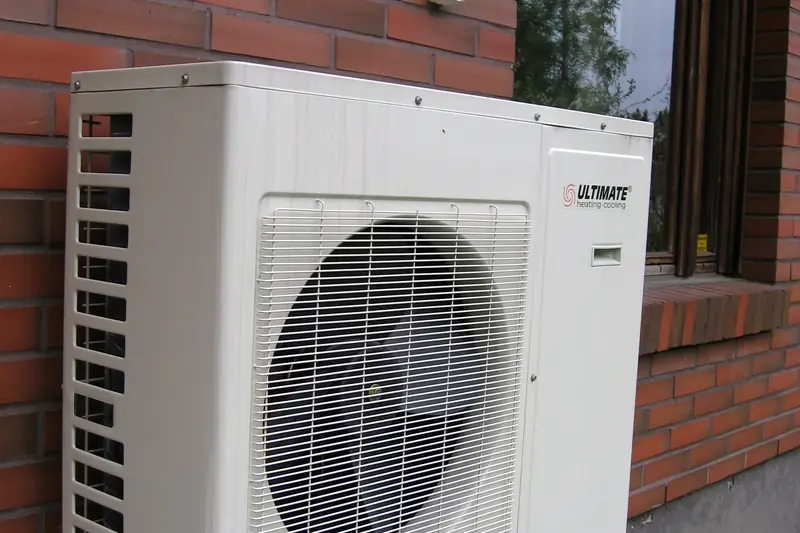
Ductless mini splits are heat pumps with an outdoor unit piped to one or more wall, ceiling or floor heads, built for rooms and homes without ducts; each head needs its own load calculation.
Read against its sources by The Second Bid · how pages are checked · Updated
Ties: Who is behind these links: The Second Bid is run by the same team that owns Plumbing Supply and More, SoftPro Water Systems and Quality Water Treatment, and that is connected to Central Plumbing & HVAC. No link here is paid placement. This page reads federal rules, ENERGY STAR and DOE criteria, ACCA's manuals and makers' own documents, checked in October 2026. Nothing was installed or measured by us; a linked business's description of its own goods is that business's claim. How these links work
Where do ductless mini splits make sense?
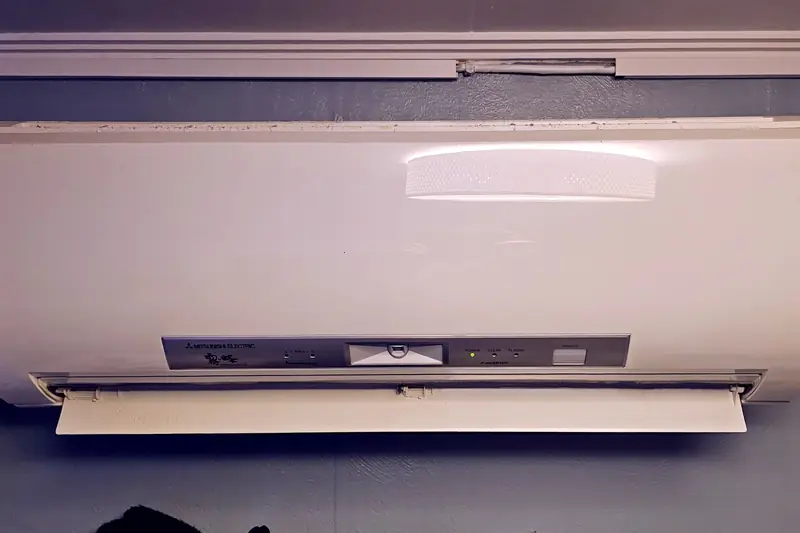
Ductless mini splits make the most sense where ducts don't exist or can't reach: additions, finished attics and garages, older homes heated by boilers or baseboards, and single rooms the central system never conditions well. ENERGY STAR says they are designed for homes or sections of homes "that do not have ductwork," including additions and outbuildings "where extending ductwork or heating/cooling capacity is difficult" (ductless heating and cooling).
They are heat pumps, so they heat and cool. DOE's 2022 Energy Saver booklet describes them as small units that "offer flexibility for zoning or heating and cooling individual rooms." Against electric baseboard or wall heaters, ENERGY STAR's up-to-60% figure is the comparison that applies.
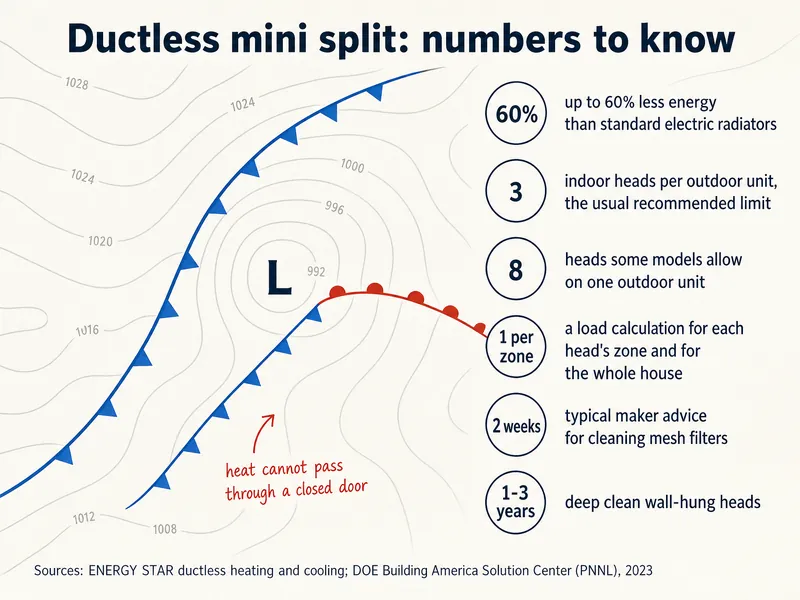
The limit is air movement. ENERGY STAR warns that heat rises and cool air sinks, and that heat has a hard time moving through an open doorway and cannot move through a closed one; one head in a hallway won't heat the bedrooms behind closed doors.
Mini split or central air?
Choose a mini split when the ducts are missing, badly placed or outside the conditioned space and can't be fixed; choose central air when good ducts already reach every room. PNNL notes that ducts and air handlers in a vented attic, crawlspace or garage lose heat and cooling, that a ductless system avoids those losses because the heads sit inside, and that ducted systems can avoid them too if everything is kept inside the thermal boundary (PNNL, 2023).
How big those losses get depends on the house. ENERGY STAR puts typical duct air loss at 20 to 30 percent; a maker, Fujitsu General, says duct losses "can account for more than 30% of energy consumption for space conditioning" in unconditioned spaces (Fujitsu General), a maker's claim and an upper case. If the existing ducts are the real problem, compare the mini split quote with one for duct repair and Manual D redesign.
| Point | Ductless mini split | Ducted central heat pump or AC |
|---|---|---|
| Ducts | None for wall heads; short-run ducted heads exist | Needs a full duct system |
| Duct losses | None from ducts; heads sit indoors | Typical 20-30% air loss (ENERGY STAR) unless ducts are inside |
| Zoning | Each head has its own control | One thermostat unless zoned |
| Air reach | Limited by walls and closed doors | Supply to each room through ducts |
| Filters | Washable mesh, about every 2 weeks (typical maker advice, PNNL) | Replaceable filter, checked monthly |
Single-zone or multi-zone?
A single-zone system is one outdoor unit and one indoor head; a multi-zone system runs several heads from one outdoor unit. PNNL says the simplest systems pair "a single outdoor unit and a single indoor unit," that one outdoor unit can serve a single ductless head, a single ducted air handler or multiple heads, and that it is "generally not recommended to connect more than three indoor units to one outdoor unit," though some models allow up to eight.
Single-zone systems tie one outdoor unit to one room's load, and a fault affects only that room. Multi-zone systems need fewer outdoor units, but every head still has to match its own zone's load, and the outdoor unit has to serve the combination. A ducted mini-split air handler with short ducts can serve several nearby rooms from one hidden unit, which PNNL also describes.
Mini split numbers with a source
- 60%up to this much less energy than standard home electric radiatorsENERGY STAR
- 3indoor units per outdoor unit, the usual recommended maximumDOE Building America Solution Center
- 8indoor units some models allow on one outdoor unitDOE Building America Solution Center
- 8.5minimum HSPF2 for an ENERGY STAR cold climate ductless splitENERGY STAR
How is each indoor head sized?
Each head is sized to the heating and cooling load of the zone it serves, from a Manual J load calculation run room by room. PNNL says the calculation "should be performed for individual zones (one per indoor unit) as well as for the entire house," and warns that "oversized or incorrectly located indoor units can result in short cycling, which wastes energy" and doesn't control temperature or humidity well.
That is the check multi-zone quotes most need: a small bedroom's load can sit well below the capacity of the head proposed for it, so compare the two numbers line by line. In a cold climate, check the outdoor unit's output at your design temperature as described in cold climate heat pump sizing, and look the matched indoor and outdoor model numbers up on the NEEP list.
Ask for: "the Manual J load for each zone next to the capacity of the head serving it, plus the outdoor unit's heating output at the design temperature."
What does a mini split installation involve?
A mini split installation sets the outdoor unit, mounts each head, and joins them with a line set, control wiring and a condensate drain through a small hole in the wall. PNNL says the refrigerant tubing and control wiring pass "through a small hole in the wall," that refrigerant may need to be added if the line set is longer than the factory charge allows, and to "make sure the condensate line and drain pans are correctly installed."
The refrigerant work is not a homeowner job. EPA's Section 608 rules prohibit venting refrigerant, and only certified technicians may buy it. New systems made since January 1, 2025 must use a refrigerant under 700 GWP, such as R-454B or R-32 (EPA sector table); see the refrigerant transition. Ask how the quote handles line set length, wall penetrations, the outdoor pad or bracket and electrical work, which often appear as installation extras.
A supply house's mini-split category (Plumbing Supply and More, run by the same team as The Second Bid) shows the single-zone and multi-zone equipment types and capacities sold, useful for knowing what a quoted model is and for the installer to quote against; it is not a do-it-yourself kit list.
What upkeep do ductless mini splits need?
Ductless mini splits need their washable filters cleaned often, a periodic deep clean of each head, and a clear outdoor unit. PNNL says a typical maker recommendation is to clean the standard mesh filters "every two weeks," and to deep clean wall-hung heads every 1 to 3 years; ENERGY STAR says to clean filters when visibly dirty or when the filter light comes on.
Homeowner tasks stop at the filters, the remote's settings and keeping snow and debris off the outdoor unit with power off at the disconnect. Deep cleaning a head's coil and blower wheel, clearing a blocked condensate line inside the head, and anything on the refrigerant side belong to a technician. If a head drips water, ices up or blows warm air in cooling mode and you're unsure why, stop and call a licensed HVAC technician.
Observation notes
This page is based on ENERGY STAR's ductless heating and cooling page and air-source heat pump criteria, the DOE Building America Solution Center (PNNL) ductless mini-split page (updated April 2023), DOE's 2022 Energy Saver booklet, Fujitsu General's mini-split page (a maker's claim, labelled as such) and EPA's Section 608 and refrigerant sector pages, read in October 2026. Left out: install-cost and equipment price ranges (no primary source), brand rankings, and do-it-yourself installation advice.
Outlook questions
Can one mini split heat a whole house?
Rarely. One head can carry an open floor plan, but ENERGY STAR notes heat struggles through doorways and can't pass closed doors, so closed bedrooms usually need their own heads or another heat source.
Are mini splits worth it in a cold climate?
Cold climate models are tested at 5°F under ENERGY STAR's label, which requires at least 8.5 HSPF2 for ductless units. Check the outdoor unit's output at your design temperature against the load before relying on it as the main heat.
Why are there short cycles with my new mini split?
PNNL links short cycling to oversized or badly located heads. Ask the installer to compare each head's capacity with its zone's Manual J load.
What is a ducted mini split?
It is a small mini-split air handler with short ducts serving several nearby rooms, connected to the outdoor unit by refrigerant tubing like any other head. It hides the indoor unit at the cost of some short duct runs.
Can I install a mini split myself?
No. The refrigerant circuit is the core of the job, and EPA restricts refrigerant purchase and handling to Section 608 certified technicians; the electrical work also needs a licensed electrician or HVAC contractor and, in many places, a permit.
How long do mini splits last?
PNNL's ductless page puts typical HVAC equipment life at 15 to 20 years, a figure not split by equipment type. Filter care and coil cleaning affect how well a unit holds its rated output.
Further along the front