SEER2 Minimums by Region
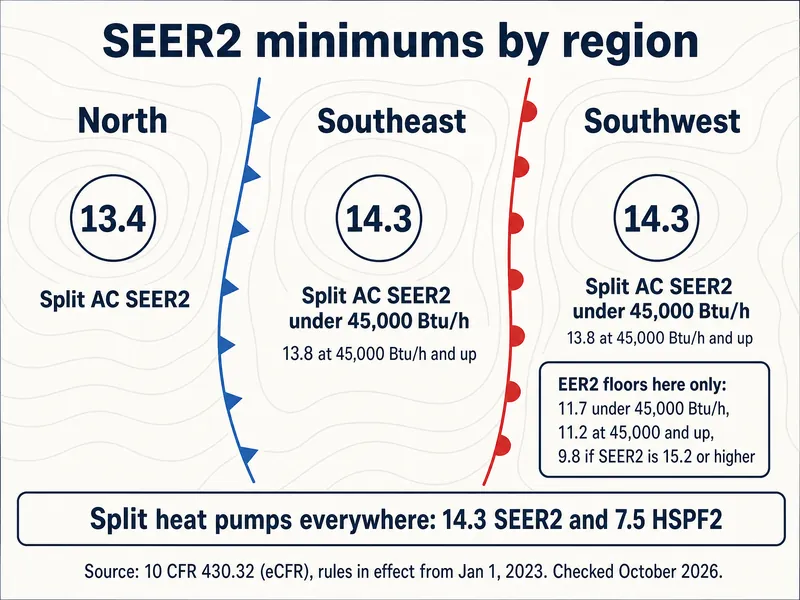
SEER2 minimums by region: a split central AC needs 13.4 SEER2 in the North and 14.3 in the Southeast and Southwest under 45,000 Btu/h; split heat pumps need 14.3 SEER2 and 7.5 HSPF2 everywhere.
Read against its sources by The Second Bid · how pages are checked · Updated
The federal floors, as of October 2026
- 13.4SEER2 minimum, split AC in the North10 CFR 430.32
- 14.3SEER2 minimum, split AC under 45,000 Btu/h in the Southeast and Southwest10 CFR 430.32
- 7.5HSPF2 minimum, split heat pumps nationwide10 CFR 430.32
- 15.2SEER2 floor for an ENERGY STAR split AC or heat pumpENERGY STAR spec v6.2
What are the SEER2 minimums by region?
The SEER2 minimum depends on equipment type and, for central air conditioners, on where the system is installed. National floors apply to everything made on or after January 1, 2023; the Southeast and Southwest add higher floors for split and packaged air conditioners "installed on or after January 1, 2023."
DOE's "Southeast" covers Alabama, Arkansas, Delaware, Florida, Georgia, Hawaii, Kentucky, Louisiana, Maryland, Mississippi, North Carolina, Oklahoma, South Carolina, Tennessee, Texas, Virginia, the District of Columbia, Puerto Rico and the U.S. territories. The "Southwest" is Arizona, California, Nevada and New Mexico. Every other state uses the national numbers, which this page calls the North.
| Product | North | Southeast | Southwest |
|---|---|---|---|
| Split AC under 45,000 Btu/h | 13.4 SEER2 | 14.3 SEER2 | 14.3 SEER2 and 11.7 EER2 (9.8 if SEER2 is 15.2+) |
| Split AC 45,000 Btu/h and up | 13.4 SEER2 | 13.8 SEER2 | 13.8 SEER2 and 11.2 EER2 (9.8 if SEER2 is 15.2+) |
| Split heat pump | 14.3 SEER2, 7.5 HSPF2 | Same | Same |
| Packaged AC | 13.4 SEER2 | 13.4 SEER2 | 13.4 SEER2 and 10.6 EER2 |
| Packaged heat pump | 13.4 SEER2, 6.7 HSPF2 | Same | Same |
Size matters because 45,000 Btu/h is 3.75 tons (a ton is 12,000 Btu/h). A 4- or 5-ton split AC in Texas meets 13.8 SEER2, while a 3-ton one needs 14.3. The Manual J load calculation decides which side of that line your home falls on.
What is SEER2 and how is it different from SEER?
SEER2 is season-long cooling efficiency: per ENERGY STAR's specification, "the total heat removed from the conditioned space during the annual cooling season, expressed in Btu, divided by the total electrical energy consumed" in watt-hours. Higher means less electricity for the same cooling.
The "2" marks a newer test. DOE's 2017 test procedure rule created appendix M1 with metrics that "generally have different numerical values than the current metrics," made mandatory from January 1, 2023, and changed the "external static pressure conditions for testing". The result is that SEER2 numbers usually read lower than old SEER numbers for the same unit.
There is no fixed SEER-to-SEER2 ratio in any DOE source, so don't let a quote convert one into the other. Compare SEER2 to SEER2. If an old bid says "16 SEER" and a new one says "15.2 SEER2," ask both installers for the SEER2 rating of the exact matched system.
What is HSPF2?
HSPF2 is the heat pump's season-long heating efficiency, the heating counterpart to SEER2. ENERGY STAR's specification defines it as the heat delivered over a season in DOE's climate region IV, in Btu, divided by the watt-hours the heat pump system used over that season.
The national floor is 7.5 HSPF2 for split heat pumps and 6.7 for packaged ones. ENERGY STAR certification asks for 7.8 HSPF2 on split systems, and its cold-climate label adds low-temperature tests at 5°F; cold-climate heat pump sizing covers those. In a cold region, HSPF2 and the 5°F capacity usually matter more to your bill than SEER2.
Why does the Southwest have EER2 rules?
EER2 is cooling efficiency at one hot test point, "95 °F dry bulb outdoor temperature" in the regulation, so it captures how a unit does on the hottest afternoons, when dry Southwest grids peak. SEER2 averages over a season and can hide weak peak performance.
The Southwest floors are 11.7 EER2 for split AC under 45,000 Btu/h and 11.2 EER2 at 45,000 and up, dropping to 9.8 EER2 when the certified SEER2 is 15.2 or higher. Packaged AC needs 10.6 EER2. The Southeast has no EER2 floor; only its SEER2 numbers rise.
Line to look for
On a cooling quote
An example line such as "Matched system: outdoor model, coil model, furnace or air handler model; certified 14.3 SEER2 / 11.7 EER2 (AHRI reference number)" lets you check the rating yourself.
Ask for
The AHRI certificate number for the exact outdoor, indoor coil and air handler or furnace combination. The AHRI Directory lists certified combinations.
Who has to meet the SEER2 minimums?
Makers must build to the national floors, and the regional floors bind at installation: the rule says an outdoor unit with "a certified combination with a rating below the applicable standard level(s) for a region cannot be installed in that region." That puts the regional rule on the installer and the distributor as well as the maker.
DOE's enforcement rules in 10 CFR 429.102 make it a violation for a contractor to knowingly install a central AC "in violation of any regional standard." In the southern states the regulation lists, installers must keep the model number, serial number, install address and date for at least 48 months. Homeowners are not the regulated party, but a noncompliant install is your system and your problem at resale or inspection; HVAC permits and inspections covers the local side.
Is a higher SEER2 worth paying for?
Sometimes. A higher SEER2 saves money in proportion to how many hours the system cools and your electricity rate, so it pays back faster in Phoenix than in Portland, Maine. ENERGY STAR's split AC and heat pump certification starts at 15.2 SEER2, with 12.0 EER2 for split AC and 11.0 EER2 for split heat pumps.
Install quality can outweigh the rating. ENERGY STAR says improper installation "can reduce system efficiency by up to 30 percent" (ENERGY STAR heating and cooling), so a correctly sized 15.2 SEER2 system with sealed ducts can beat an oversized 18 SEER2 one. Compare bids on matched-system ratings, sizing and duct work together, as how to compare HVAC quotes sets out, and check oversized AC problems before paying for capacity.
Observation notes
This page reads 10 CFR 430.32 (current eCFR text), 10 CFR 429.102 and 429.142 (DOE regional enforcement), DOE's January 5, 2017 test procedure final rule, the ENERGY STAR Version 6.2 central AC and heat pump specification and ENERGY STAR's heating and cooling page, all read October 27, 2026. Left out: a SEER-to-SEER2 conversion factor (no DOE source), payback figures and install cost ranges (no primary source), and pre-2023 SEER minimums except as history.
Outlook questions
Is 14 SEER still the minimum in the South?
No. That pre-2023 SEER figure was replaced. From January 1, 2023 the Southeast and Southwest floor for split AC under 45,000 Btu/h is 14.3 SEER2, and 13.8 SEER2 at 45,000 Btu/h and up.
Can an installer in Florida use leftover 13.4 SEER2 AC stock?
Not for a split AC under 45,000 Btu/h. The regulation says a combination rated below the regional level "cannot be installed in that region," whatever its build date.
Does the regional rule apply to heat pumps?
No. Split heat pumps have one national floor, 14.3 SEER2 and 7.5 HSPF2, in every region.
Why does my outdoor unit's rating change with the indoor coil?
SEER2 is certified for a matched combination of outdoor unit, coil and air handler or furnace. A different indoor match can rate higher or lower, which is why the AHRI number matters.
Does Texas have an EER2 requirement?
No. Texas is in DOE's Southeast region, which has SEER2 floors only. The EER2 floors apply in Arizona, California, Nevada and New Mexico.
Does a higher SEER2 mean better dehumidification?
Not by itself. Humidity control depends on sizing, airflow and how long the system runs; an oversized high-SEER2 unit can short-cycle and leave air damp.
Where can I see the regulation text?
The current text is in 10 CFR 430.32 on eCFR, sections (c)(5) for national floors and (c)(6) for the regional ones.
Further along the front