What an HVAC Quote Should Include
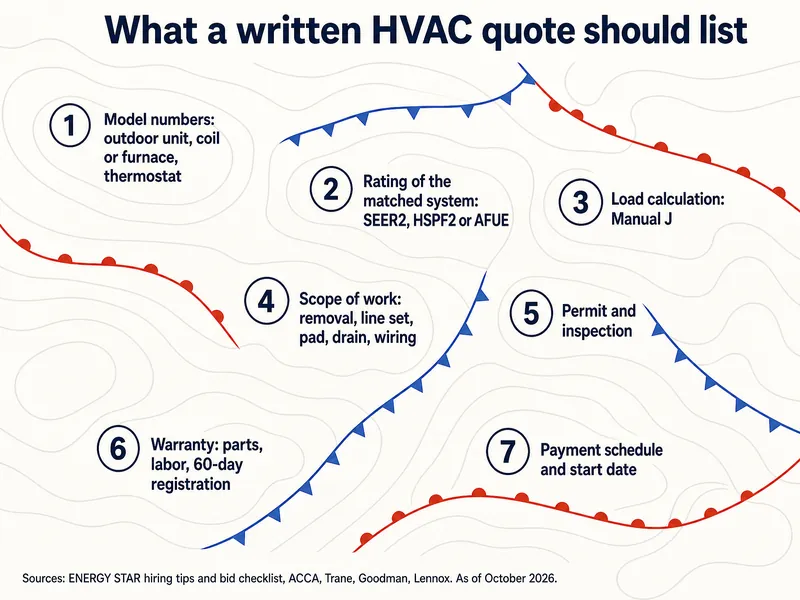
An HVAC quote should include every model number, the matched system's rating, the load calculation behind its size, a written scope, the permit, warranty terms and a payment schedule, so two bids can be compared line for line.
Read against its sources by The Second Bid · how pages are checked · Updated
Ties: Who is behind these links: The Second Bid is run by the same team that owns Plumbing Supply and More, SoftPro Water Systems and Quality Water Treatment, and that is connected to Central Plumbing & HVAC. No link here is paid placement. This page reads federal rules, ENERGY STAR and DOE criteria, ACCA's manuals and makers' own documents, checked in October 2026. Nothing was installed or measured by us; a linked business's description of its own goods is that business's claim. How these links work
What the paperwork should carry
- 700GWP ceiling for refrigerant in new split systems made from January 1, 2025EPA
- 7.5HSPF2 floor for split heat pumps, beside 14.3 SEER210 CFR 430.32
- 20%total duct leakage ENERGY STAR's checklist recommends not exceeding, in most casesENERGY STAR bid checklist
- 60 dayswindow to register for Lennox's extra five years of parts coverageLennox
What should an HVAC quote include at minimum?
At minimum, an HVAC quote should list the equipment by model number, the size and efficiency rating, what work is included, who handles the permit, the warranty terms, the price and the payment schedule. ENERGY STAR's hiring tips describe the same core: a written proposal "specifying project costs, model numbers, job schedule and warranty information", signed before work starts. Anything that isn't on paper is a promise you can't compare.
The table below turns those items into lines you can check off. When one is missing, ask for it in writing rather than accepting a verbal answer; that also makes a line-by-line comparison of HVAC quotes possible.
| Line | What a complete version says | Why it matters |
|---|---|---|
| Equipment | A model number for each piece: condenser or heat pump, coil or air handler, furnace, thermostat | Lets you look up ratings and warranty |
| Size | Tons or Btu/h, plus the Manual J load it was picked from | 1 ton is 12,000 Btu/h; oversizing causes short cycling |
| Rating | SEER2, EER2 and HSPF2 for the matched pair, or AFUE | Federal floors differ by region and product |
| Scope | Removal, line set, pad, condensate drain, electrical, duct work | Where bids differ most |
| Startup | Charge and airflow measured, readings written down | Named on ENERGY STAR's installation checklist |
| Permit | Who files, which inspections | Rules are set by each city or county |
| Warranty | Maker parts term, contractor labor term, who registers | Parts warranties usually exclude labor |
| Money | Total, deposit, payment dates, start and finish dates | Ties payment to finished work |
Why do model numbers matter?
Model numbers matter because the efficiency rating, refrigerant, warranty and even legality in your region belong to specific models, not to a brand or series name. A line such as "16 SEER2 heat pump" tells you nothing you can verify; a line with the outdoor and indoor model numbers can be checked against the AHRI Certification Directory, where certified matched systems are listed. ENERGY STAR's checklist says your contractor should provide an AHRI certificate to document that the system was properly matched.
Model numbers also settle the refrigerant question. New split systems made or imported from January 1, 2025 must use a refrigerant under 700 GWP, such as R-454B or R-32, per EPA's sector table; EPA's May 26, 2026 rule lets older R-410A inventory still be installed, and that rule is being challenged in court. The refrigerant change page explains the dates.
If you want to see what the equipment category looks like before reading model numbers, a supply house's unitary HVAC equipment range (Plumbing Supply and More, run by the same team as The Second Bid) shows condensers, air handlers and coils side by side; it is there for knowing what the parts are, and the installer quotes and fits them.
Line to look for
The equipment block
An illustration: "Outdoor heat pump model and indoor coil model as listed, AHRI certified reference number listed; programmable thermostat rated for heat pumps."
The rating line
An illustration: "Matched rating: 15.2 SEER2, 11.0 EER2, 7.8 HSPF2", the ENERGY STAR minimums for a split heat pump, so you can see what a complete rating line carries.
Should a quote include a load calculation?
Yes. A quote should include, or attach, the Manual J heating and cooling loads that the equipment size was picked from. ACCA describes Manual J as the ANSI-recognized standard for sizing loads in homes, and Manual S as the method that picks equipment to match them with size limits. The International Residential Code (section M1401.3) calls for sizing by Manual S from Manual J loads, though local adoption and enforcement vary.
Floor area alone doesn't set size. ENERGY STAR's quality installation page tells homeowners not to "just rely on a 'rule of thumb'" and warns that oversized equipment "may cycle too frequently, resulting in less comfort and a shortened lifespan." The Manual J explainer shows what a load report contains, and oversized AC problems covers what happens when it is skipped.
What scope of work belongs in the quote?
The scope should name every job the crew will do and every job it won't: removal and disposal of old equipment, the refrigerant line set, the outdoor pad, the condensate drain and trap, the electrical disconnect and wiring, duct changes, the thermostat, startup testing and cleanup. ENERGY STAR's quality installation page asks contractors to make sure airflow meets the maker's specifications, to test and adjust the refrigerant charge, and to inspect the ducts and run a leakage test.
The line set is a common gap. The quote should say new or reused; ENERGY STAR's checklist puts that exact question to every bidder. Line sets are sold as pre-insulated copper pairs in set lengths (see a supply house's line set range (Plumbing Supply and More, run by the same team as The Second Bid)) for the installer to quote against; connecting and charging them is a job for a Section 608-certified technician. The installation extras page lists the other add-on lines, and Manual D duct design covers duct scope.
What payment and warranty terms should it show?
The quote should show the total, the deposit, what is due at each stage and the start and finish dates, plus three warranty facts: the maker's parts term, the contractor's labor term and who registers the equipment. Tying the final payment to a finished, inspected job keeps the incentives lined up.
Maker terms hinge on registration. Trane says registering within 60 days lengthens its warranty, "in most cases" to 10 years against five for the base term, covering parts and "not the labor". Goodman gives 5 years of parts coverage without action and 10 with registration within 60 days, and residents of California, Florida, Georgia and Quebec don't need to register. Lennox adds five years for products registered within 60 days, for ten in total on qualifying parts. The warranty registration page explains who should file it.
Ask for
Labor years in writing
The number of years the contractor covers labor, separate from the maker's parts warranty.
Proof of registration
A copy of the maker's registration confirmation within the 60-day window, or a note that your state is exempt.
What is usually left off?
The lines most often missing are the load calculation, the startup record, the permit, duct testing and anything about money programs. ENERGY STAR's checklist asks contractors to leave "all manuals" plus documentation including "Manual J calculations, AHRI certificate, and records of any measurements or testing"; few quotes promise that unless asked.
Money lines need care too. Under the IRS's 2025 law-change FAQ, 25C stopped with property put in service by the end of 2025, so a quote written this year shouldn't net it out (IRS FAQ). State-run Home Energy Rebates changed under DOE Program Notice 26-2, effective May 29, 2026: heat pump rebates now cover replacing electric equipment rather than gas or oil. See the heat pump tax credit page, and the red flags list if a missing line looks deliberate.
Observation notes
Read in October 2026: ENERGY STAR's hiring tips, its quality installation page and the undated bid checklist it still links; ACCA's pages on Manual J and Manual S; the 2015 text of IRC section M1401.3, as quoted by the Texas Department of Housing and Community Affairs; the SEER2 and HSPF2 table in 10 CFR 430.32; EPA's refrigerant sector table and its May 26, 2026 rule; the IRS FAQ on 25C; DOE Program Notice 26-2; and warranty pages from Trane, Goodman and Lennox. Supply-house links show part categories only. Left out: installed prices and cost ranges, which no primary source publishes.
Outlook questions
Should an HVAC quote list the indoor coil model as well as the outdoor unit?
Yes. Cooling and heat pump ratings are certified for the pair, outdoor section plus indoor coil, so the coil model is needed to confirm the rating and to find the AHRI certificate.
Is a verbal promise about the warranty enough?
No. ENERGY STAR advises signing a written proposal that specifies warranty information before work starts. Ask for parts and labor years as separate written lines.
Does the quote need to say R-454B or R-32?
It should name the refrigerant or give model numbers that show it. Equipment made from 2025 on uses a refrigerant under 700 GWP; older R-410A stock can still be installed under EPA's 2026 rule.
What should a quote say about ducts?
It should state whether the crew checks the ducts, tests them for leaks and fixes what it finds, or leaves them alone. ENERGY STAR's checklist recommends total duct leakage of no more than 20% in most cases.
Should the permit fee be a separate line?
It helps. A separate permit line shows who files it and that the cost is included. Whether a permit is required depends on your city or county, so ask the building office if unsure.
Can I ask for the Manual J report after signing?
You can, but it is easier before. ENERGY STAR's checklist lists Manual J calculations among the documents a contractor should leave after installation.
Should a quote mention rebates?
Only with the program's name and rules. Home Energy Rebates are run by state energy offices, and under DOE's 2026 notice a heat pump rebate needs existing electric heat or new construction.
Further along the front
Back to The Second Bid front page