Oversized AC Problems
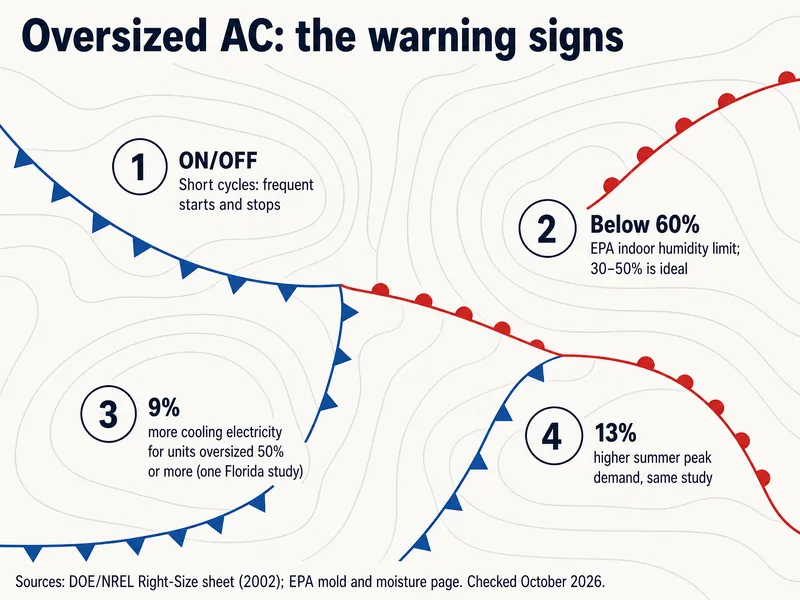
Oversized AC problems come from running in short bursts: the system cools the air fast but shuts off before it removes much moisture, so rooms feel clammy, temperatures swing and parts wear sooner.
Read against its sources by The Second Bid · how pages are checked · Updated
What oversized AC problems do homeowners notice?
The oversized AC problems people notice first are short run times, a damp or clammy feel, and rooms that swing between too cold and too warm. ENERGY STAR's 2009 heating and cooling booklet says a system that's too large "will not keep your home comfortable because of frequent 'on/off' cycling", and that incorrect sizing can "put stress on system components and shorten the equipment's life."
Bills can rise too. The DOE/NREL Right-Size sheet (2002) says oversized systems "use more fan power for the blower and often exhibit more duct leakage due to higher operating duct pressures." It also notes they "greatly aggravate the summer utility peak demand on hot days."
Why does an oversized AC leave rooms humid?
An oversized AC leaves rooms humid because it reaches the thermostat setting before it has run long enough to pull much water out of the air. Dehumidifying happens on the cold indoor coil, and a short cycle ends before the coil does much of that work. DOE's 2002 sheet puts it directly: in humid climates, "short-cycling of air conditioning equipment can lead to poor humidity control."
The target is about 30–50% relative humidity, with 60% as the upper limit, per EPA's mold and moisture page. Above that, EPA links moisture to mold growth. ENERGY STAR's quality installation page adds that poor airflow can also produce "overly damp air", so humidity alone doesn't prove oversizing.
What is short cycling?
Short cycling is a system turning on and off much more often than normal, with each run too brief to settle into steady operation. DOE's 2002 sheet compares it to "an automobile in stop-and-go traffic": efficiency drops, and "more starts and stops accelerate wear and tear on the equipment, which can lead to premature failure."
Oversizing is one cause, but not the only one. A thermostat placed near a supply register, a dirty filter, low refrigerant charge or a failing control can also cause short cycles. ACCA's Manual S sets size limits that it says help prevent "short cycling or safety switch triggers in the units." If you're unsure, stop and call a licensed HVAC technician.
How can you tell if your AC is oversized?
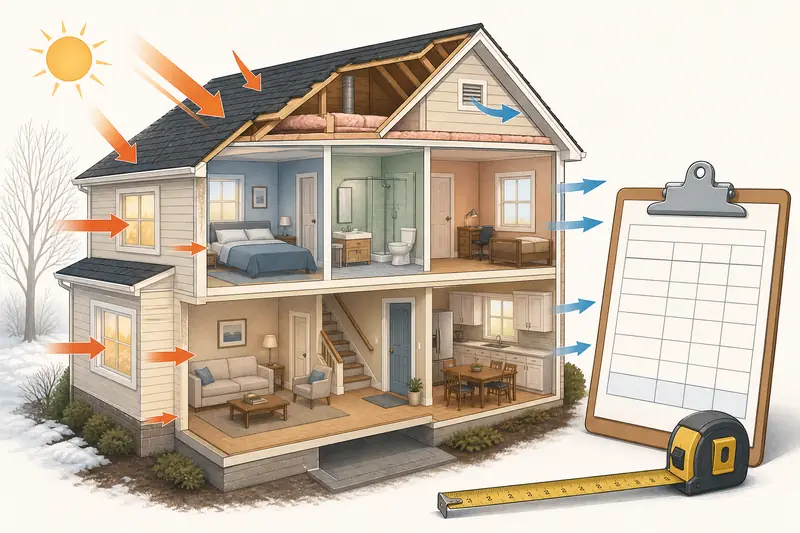
You can tell an AC is likely oversized by comparing its capacity to a load calculation, not by feel alone. The definite check is a Manual J load calculation set against the unit's capacity. ENERGY STAR's new-construction HVAC supplement calls the ratio "cooling sizing %": total capacity divided by maximum heat gain.
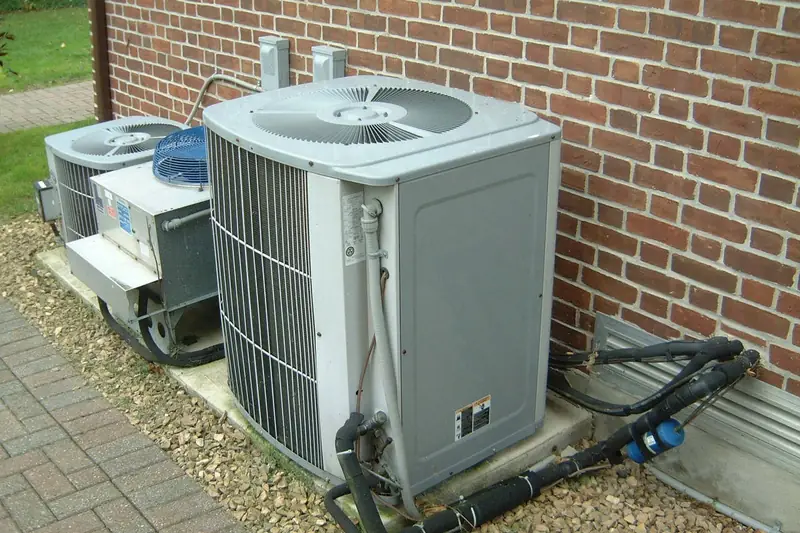
Homeowner clues are worth writing down before a technician visits. Time a few cycles on a hot afternoon with a watch, read an indoor humidity meter, and note the model number from the outdoor unit's nameplate. A unit that runs only briefly on the hottest afternoons while the house stays above 50% humidity is a reason to ask for the load.
| Clue | Points to oversizing when | Other common causes |
|---|---|---|
| Short run times | Hottest afternoons, clean filter | Thermostat near a register, control fault |
| Indoor humidity above 50–60% | Unit runs briefly, cools fast | Low airflow, leaky return ducts |
| Uneven rooms | Whole house swings together | Duct design or leakage (ENERGY STAR: 20–30% air lost) |
| Higher bills | Capacity well above the Manual J load | Duct leakage, low charge, dirty coil |
Do two-stage and variable systems help?
Two-stage and variable-speed systems help because they run at lower capacity most of the time, giving longer cycles and more dehumidification. ENERGY STAR's new-homes table reflects that, recommending up to 120% of the load for two-stage and 130% for variable-speed, against 115% for single-speed.
The 2015 IRC text quoted by Texas TDHCA also lets "multistage technology or variable refrigerant flow technology" exceed Manual S limits when the calculated loads fall within the maker's published capacity range. The low stage still has to be small enough for mild days, so ask for the minimum capacity as well as the maximum. ACCA says the 2023 Manual S adds "more guidance on the use of dehumidifiers."
What to ask for on a replacement
Ask for
A Manual J heat gain and the proposed unit's capacity at your design temperature, side by side.
Ask for
For two-stage or variable units: the lowest-stage capacity in Btu/h, not only the nameplate tonnage.
Line to look for
An example line such as: "Cooling sizing: 108% of Manual J total heat gain (single-stage)."
What can you do about an oversized AC?
You can reduce the symptoms now and right-size at replacement. First rule out the other causes: replace a dirty filter, keep registers open, and have the airflow and charge checked; ENERGY STAR asks contractors to make airflow meet "manufacturer performance specifications." Sealing leaky ducts helps too, since ENERGY STAR finds typical ductwork leaks a fifth or more of its air.
A dehumidifier can handle the moisture an oversized unit leaves behind. When the system is due, ask for a fresh load calculation; DOE's 2002 sheet notes that as a home gets more efficient, the recommended system size "should drop." The what size AC do I need page and HVAC quote red flags cover the quote side.
Oversizing in numbers
- 9%extra annual cooling use when units were 50%+ too big, FloridaDOE/NREL Right-Size sheet (2002)
- 13%higher summer peak demand, same studyDOE/NREL Right-Size sheet (2002)
- 30–50%ideal indoor relative humidityEPA
- Up to 30%efficiency lost to improper installationENERGY STAR
Observation notes
Based on DOE/NREL's 2002 right-sizing publication and its Florida study figures, ENERGY STAR's quality installation, duct sealing and heating-and-cooling pages, ENERGY STAR's 2009 heating and cooling booklet, ENERGY STAR's new-construction HVAC supplement, EPA's mold and moisture page, ACCA's Manual S page and the 2015 IRC exception for multistage equipment as reprinted by Texas TDHCA. Everything was checked during October 2026. Sample quote lines are made up to show the format. Left out: cycle-length targets in minutes (no primary source found), dehumidifier sizing and prices.
Outlook questions
How many times an hour should an AC cycle?
This site found no agency figure for a normal cycle count, so it doesn't give one. Short, frequent cycles on the hottest afternoons are the pattern worth recording for a technician.
Is a clammy house always a sign of an oversized AC?
No. ENERGY STAR's replacement checklist says "poor equipment operation, inadequate equipment, and leaky ductwork" can all leave air too humid in summer. A load calculation and an airflow check separate the causes.
Does a dehumidifier fix oversized AC problems?
It treats the moisture, not the cycling. A whole-house or portable dehumidifier can hold humidity under EPA's 60% ceiling while you wait to right-size the AC at replacement.
Is an oversized heat pump a problem in winter too?
In heating, the bigger risk is usually the reverse: too little capacity in cold weather. ACCA's 2023 Manual S added expanded tolerances for variable-capacity heat pumps; see the cold climate heat pump sizing page.
Will a smart thermostat fix an oversized AC?
It can't add run time the load doesn't need. A thermostat decides when the system runs, not how much capacity it has, so the size mismatch remains.
Can I downsize the AC without replacing the ducts?
Often yes, since a smaller unit moves less air. The ducts still need checking under Manual D so airflow matches the new unit.
Further along the front