HVAC Quote Red Flags to Question
HVAC quote red flags are lines that can't be checked: a size picked from floor area, missing model numbers, a price that expires today, no permit, unexplained part add-ons and talk of an R-410A ban.
Read against its sources by The Second Bid · how pages are checked · Updated
Ties: Who is behind these links: The Second Bid is run by the same team that owns Plumbing Supply and More, SoftPro Water Systems and Quality Water Treatment, and that is connected to Central Plumbing & HVAC. No link here is paid placement. This page reads federal rules, ENERGY STAR and DOE criteria, ACCA's manuals and makers' own documents, checked in October 2026. Nothing was installed or measured by us; a linked business's description of its own goods is that business's claim. How these links work
Numbers behind the red flags
- 9%typical rise in cooling electricity for units oversized by 50% or more, one Florida studyDOE/NREL 2002
- 30%efficiency improper installation can cost, at mostENERGY STAR
- 700GWP limit for refrigerant in new split systems made from January 1, 2025EPA
- $8,000federal ceiling for a heat pump under Home Energy Rebates, now limited to replacing electric equipmentENERGY STAR
What are the biggest HVAC quote red flags?
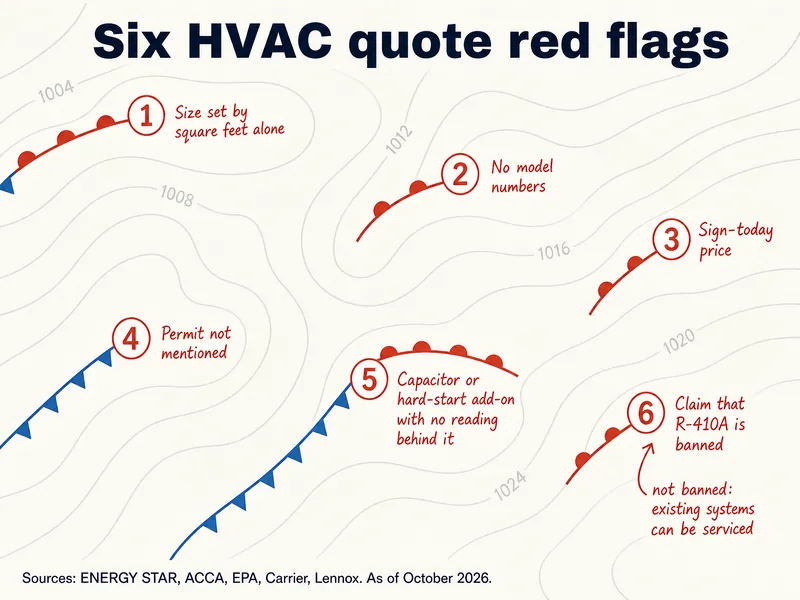
The biggest HVAC quote red flags are the ones that stop you checking the work: no load calculation, no model numbers, no written scope, no permit and a deadline that makes you skip the comparison. None proves a contractor is dishonest. Each one is a line to question before you sign, because a quote you can't verify can't be compared.
The table sorts the common flags by what to ask and which source backs the question. Where a flag turns out to be a simple omission, a good contractor fixes it in writing within a day or two.
| Red flag | Ask for | Source behind the question |
|---|---|---|
| Size from floor area alone | The Manual J load report | DOE/NREL 2002; ENERGY STAR quality installation |
| "Heat pump, 16 SEER2" with no models | Outdoor and indoor model numbers, AHRI reference | ENERGY STAR hiring tips and bid checklist |
| Price valid today only | Time to compare, in writing | ENERGY STAR: sign a written proposal before work starts |
| Permit not mentioned | Who files it, which inspections | Your city or county building office |
| Capacitor or hard-start kit added | The symptom or reading behind it | Lennox and Carrier capacitor pages |
| "There's an R-410A ban, replace now" | The EPA rule it relies on | EPA FAQ and May 26, 2026 final rule |
| 2026 federal tax credit deducted | The IRS citation | IRS 25C FAQ |
Why is square-foot sizing a red flag?
Square-foot sizing is a red flag because floor area ignores insulation, windows, air leakage, orientation and climate, which are what set a home's heating and cooling load. DOE's 2002 right-sizing sheet says the procedures recommended in the United States are Manual J and Manual S, and ENERGY STAR's quality installation page tells homeowners not to "just rely on a 'rule of thumb.'" No federal agency publishes a floor-area-per-ton figure.
Oversizing has a cost. ENERGY STAR says oversized equipment "may cycle too frequently, resulting in less comfort and a shortened lifespan", and the DOE sheet notes short cycling hurts humidity control in humid climates. The Manual J explainer shows what a real load report contains, and what size AC do I need turns it into tons.
Line to look for
A sized line
An illustration: "Heat gain 29,800 Btu/h and heat loss 41,200 Btu/h per Manual J; 2.5-ton unit selected per Manual S."
Not this
An illustration of the flag: "2,000 sq ft home, 4-ton system", with no calculation attached.
Which pressure tactics should worry you?
Worry about any tactic that removes your time to read and compare: a price that expires when the salesperson leaves, a discount for signing before the inspection is finished, or a full payment demanded up front. ENERGY STAR's hiring tips say the contractor should inspect the system and home, then give a written proposal you sign "before work gets started"; a quote produced in minutes skips the first step.
A no-heat or no-cooling emergency is the hardest case, since speed matters. Ask for the repair that restores operation now, in writing, and keep the replacement decision separate until you have a second written bid. The questions to ask an HVAC contractor cover payment timing, and getting a second opinion explains when a repair quote deserves one.
Are capacitor and hard-start upsells red flags?
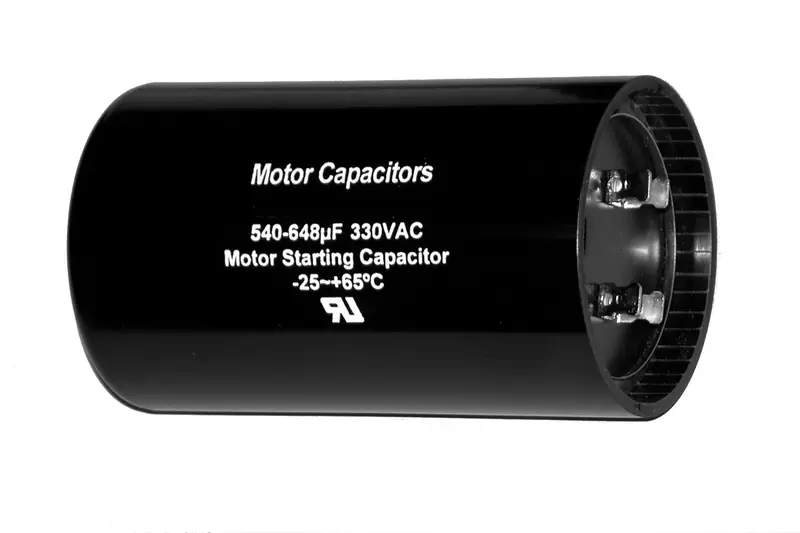
A capacitor or hard-start kit on a quote is a red flag only when no symptom or reading explains it. Lennox says an AC capacitor "stores energy to start and stabilize compressor and fan motors" and that failure "causes hard starts, humming, or no cooling" (Lennox). Capacitors are made in sizes printed on their labels, as a supply house's capacitor range (Plumbing Supply and More, run by the same team as The Second Bid) shows; knowing that helps you ask why one was swapped.
A hard-start kit is not routine equipment. For the Lennox EL16KC1 condenser, the maker's product specifications say its PSC compressor motor "normally does not need a potential relay and start capacitor" and that a kit "may be required" under conditions such as low voltage. Ask which condition applies, whether the kit is one the maker approves, and whether it is fixing a cause or masking a failing compressor. The supply house's hard-start kit category (Plumbing Supply and More, run by the same team as The Second Bid) is there to show what the part is, for the installer to quote against.
Never handle these parts yourself. Carrier warns that capacitors "store high-voltage electricity that can cause serious injury or death, even when the power is disconnected", so leave capacitor and hard-start replacement to a licensed technician. Your own checks stop at the thermostat setting and the breaker: reset a tripped breaker once, and if it trips again, leave it off. If you're unsure, stop and call a licensed HVAC technician.
What refrigerant claims are misleading?
The misleading claims are that a ban on R-410A is in force, that an R-410A system is no longer repairable, or that January 1, 2026 was the last day to install one. EPA's final rule of May 26, 2026, effective July 27, 2026, lets equipment made or imported before January 1, 2025 "continue to be installed"; the rule is being challenged in court. EPA's FAQ adds: "Yes, you can continue to repair your existing refrigeration, air conditioning, and heat pump system."
What is true: new split systems made from January 1, 2025 must use a refrigerant under 700 GWP, such as R-454B or R-32, and only Section 608-certified technicians can buy refrigerant, per EPA's sales restriction page. Replacing an older system can still be the right call, but for age, repairs and comfort, not a ban. The refrigerant change page has the dates, and repair or replace covers the decision.
Money claims deserve the same check. A 2026 bid that deducts the 25C credit is wrong, and "get $8,000 to swap your gas furnace for a heat pump" no longer fits Home Energy Rebates: DOE removed fuel switching in Program Notice 26-2, in force from May 29, 2026. See Home Energy Rebates in 2026.
What should you do when you spot one?
Ask for the missing line in writing, give the contractor a fair chance to supply it, and compare the answer with a second bid. Most flags are omissions that a careful contractor can fix: a load report, model numbers, a permit line or a reason for a part.
If the answer doesn't come, or the price changes when you ask, treat that as information. Line the bids up with the quote comparison worksheet and check them against what an HVAC quote should include. For licensing, ENERGY STAR suggests you "find out about license and insurance requirements for contractors in your state."
Observation notes
Sources read in October 2026: DOE/NREL's 2002 right-sizing sheet; ENERGY STAR's hiring tips, quality installation page and heating and cooling efficiency page; ACCA's Manual J page; Lennox and Carrier capacitor pages and the Lennox EL16KC1 product specifications; EPA's refrigerant FAQ, sector table, sales restriction page and May 26, 2026 final rule; the IRS 25C FAQ; DOE Program Notice 26-2; and ENERGY STAR's Home Energy Rebates table. Left out: capacitor sizes, testing steps and prices, contractor complaint stories and any cost range for repairs or installs.
Outlook questions
Is it a red flag if a contractor sizes my AC without coming inside?
Usually. Without seeing insulation, windows and ducts, the size can only come from floor area or the old unit's label. ENERGY STAR expects a contractor to spend significant time inspecting the home first.
Is replacing the same size as my old unit a red flag?
It can be. The old unit may have been oversized, or the house may have changed with new windows or insulation. Ask for a Manual J load before matching the old tonnage.
Should I worry if a technician replaces a capacitor on a service visit?
Not by itself; Lennox lists hard starts, humming and no cooling as signs of a failed capacitor. Ask what symptom or reading led to it, and keep the old part's label if you want a second opinion.
Is a hard-start kit a fix for an old compressor?
Not as a rule. Lennox describes the kit as an accessory for conditions such as low voltage. If the compressor is failing, a kit may only delay the decision.
A contractor says my R-410A system can't be recharged. Is that true?
No. EPA says existing systems can still be repaired, including major components. Refrigerant is bought and handled only by Section 608-certified technicians.
Is a big discount for signing today always a bad sign?
It is a sign to slow down. Ask for the same price in writing with a date a few days out, so you can compare it with another bid.
What if a quote leaves the permit out?
Ask who files it. Rules vary by city and county; some require a permit for any furnace or AC replacement and some exempt like-for-like electric units.
Further along the front

Back to The Second Bid front page