Dual Fuel Heat Pumps: Heat Pump Plus Furnace
A dual fuel heat pump pairs an electric heat pump with a gas or oil furnace: the heat pump cools in summer and heats in mild weather, and the furnace takes over below a switchover temperature the thermostat controls.
Read against its sources by The Second Bid · how pages are checked · Updated
Ties: Who is behind these links: The Second Bid is run by the same team that owns Plumbing Supply and More, SoftPro Water Systems and Quality Water Treatment, and that is connected to Central Plumbing & HVAC. No link here is paid placement. This page reads federal rules, ENERGY STAR and DOE criteria, ACCA's manuals and makers' own documents, checked in October 2026. Nothing was installed or measured by us; a linked business's description of its own goods is that business's claim. How these links work
How do dual fuel heat pumps work?
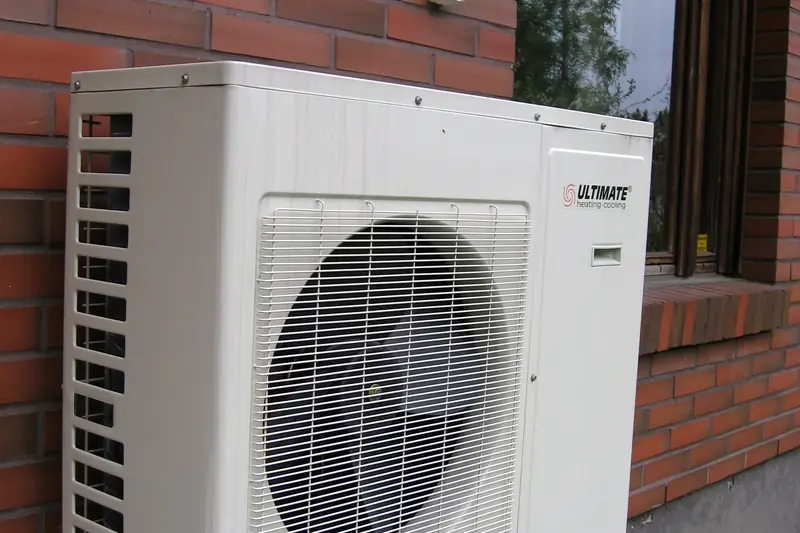
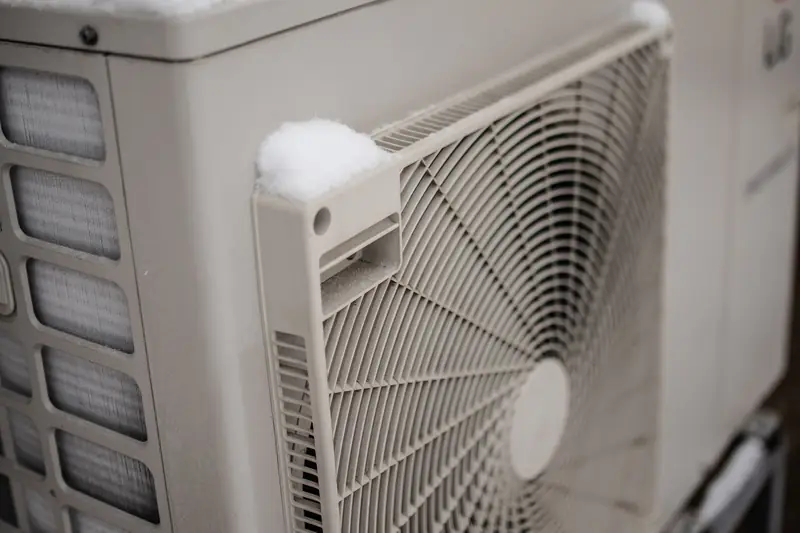
A dual fuel heat pump is two heat sources on one air handler: an outdoor heat pump with its coil on top of a gas furnace, run by one thermostat that picks which one heats. In summer the heat pump is simply the central air conditioner. In mild heating weather it moves heat indoors; when the outdoor air gets cold enough, the thermostat stops the heat pump and fires the furnace.
Trane's dual fuel glossary entry describes the system as guided by "outdoor temperature sensors and a smart thermostat," switching to the furnace when the heat pump "can no longer operate efficiently" and back again when it warms up. ENERGY STAR says the pairing lets you use each system "optimally based on costs and environmental benefits."
The furnace is usually the existing one or a new unit sized for the full heating load, since it carries the coldest hours alone. That makes dual fuel a common path for homes that want a heat pump without giving up gas heat on the worst nights; heat pump vs furnace covers the choice between them.
When do dual fuel heat pumps switch to gas?
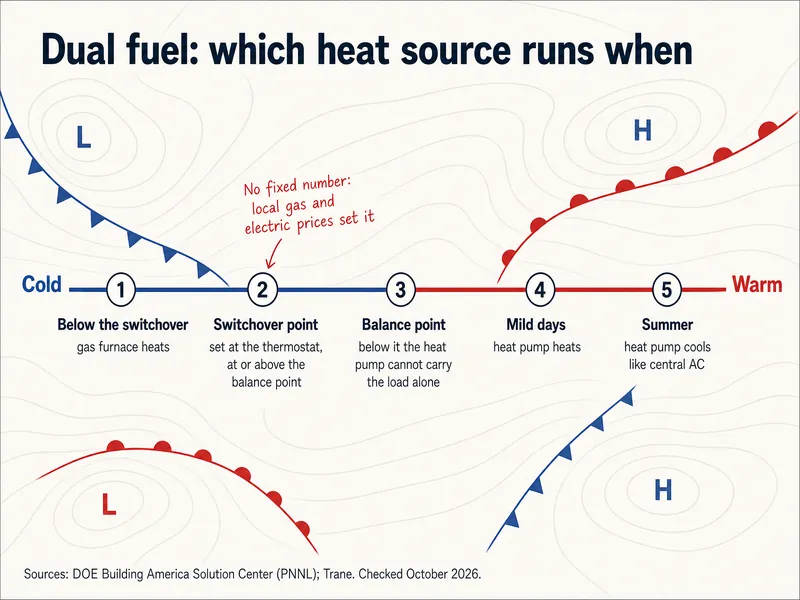
A dual fuel heat pump switches to gas at the temperature set in the thermostat, and the right setting sits at or above the home's balance point. PNNL's cold climate sizing page says that below the balance point "the heat pump cannot fully meet the home's heating needs without a backup heat source," and with a switchover strategy all the heat below that line comes from the backup.
Above the balance point the choice is about money. If gas is cheap and electricity is expensive, it can pay to switch earlier than the balance point requires; if electricity is cheap, the heat pump can carry the load down to the balance point. Because that depends on local rates and the specific equipment, this site gives no fixed switchover number.
| Setting | What it means | Who sets it, from what |
|---|---|---|
| Balance point | Outdoor temperature where heat pump output equals the home's heat loss | Installer, from the Manual J load and the maker's capacity table (PNNL) |
| Economic switchover | Temperature below which gas heat costs less per unit of heat | Installer and owner, from local gas and electric rates |
| Compressor minimum (one maker's term) | Thermostat setting that stops the heat pump below an outdoor temperature | Set at commissioning (DOE training example) |
| Aux heat maximum (one maker's term) | Thermostat setting that stops the furnace above an outdoor temperature | Set at commissioning (DOE training example) |
Dual fuel numbers on the record
- 50–65%Less electricity for heating than electric resistance heat (not a comparison with gas); DOE gives about 65% on this page and about 50% in its 2022 bookletU.S. Department of Energy
- About 35°FOutdoor temperature below which standard heat pumps often need backup heatPNNL Building America Solution Center
- 1.75Minimum COP at 5°F for an ENERGY STAR cold-climate heat pumpENERGY STAR
- 70%Heating capacity kept at 5°F versus 47°F, same ENERGY STAR criteriaENERGY STAR
Who are dual fuel heat pumps right for?
Dual fuel heat pumps fit homes that already have gas, need air conditioning anyway, and have winters cold enough that a heat pump alone would need a lot of backup heat. Replacing an AC with a heat pump on top of a working furnace is the typical case ENERGY STAR describes.
They fit less well where gas isn't available, where winters are mild enough for a heat pump with small strip heaters, or where a cold climate heat pump sized to the heating load can carry the house; see cold climate heat pump sizing. Where the furnace is old, the evaluation should cover both halves: ENERGY STAR suggests a contractor look at furnaces over 15 years old and heat pumps or ACs over 10 (when to replace).
On rebates, DOE's Program Notice 26-2 (May 29, 2026) removed fuel switching from the federal state-run rebates but the same notice lets a home keep its existing fossil-fuel system when a heat pump goes in, even if the heat pump isn't the main heat source. How a state applies that to a dual fuel install is the state's call; check home energy rebates and ask your state energy office before counting on one.
What thermostat does a dual fuel system need?
A dual fuel system needs a thermostat, or a maker's control board, set up for a heat pump with fossil-fuel backup, with an outdoor temperature input and lockout settings. A DOE Building Science Education training document (dual fuel thermostats) walks through one smart thermostat's "Compressor Minimum Outdoor Temperature" and "Aux Heat Max Outdoor Temperature" settings, which stop the heat pump below one temperature and the furnace above another.
Its example values are an illustration of the menus, not a recommendation; the settings should come from the balance point and your rates. Avoid large manual setbacks on the heat pump side: DOE's 2022 Energy Saver booklet says not to set back a heat pump without a smart or programmable thermostat designed for heat pumps.
A supply house's thermostat range (Plumbing Supply and More, run by the same team as The Second Bid) shows how many models list dual fuel or heat pump support, which helps when reading a quote's model number; wiring and configuring it is the installer's job.
What does a dual fuel quote need to show?
A dual fuel quote needs to name both halves as a matched system and say how they will be controlled. ENERGY STAR asks that the written proposal specify "project costs, model numbers, job schedule and warranty information" (10 tips for hiring); for dual fuel, add the control details below.
Lines to look for and ask for
Line to look for
Wording along the lines of: "Heat pump and indoor coil model numbers listed as a matched combination with the existing (or new) furnace; outdoor sensor included."
Ask for
The balance point from the Manual J load and the heat pump's capacity table, and the switchover setting proposed, with the reason.
Ask for
Confirmation that the furnace and heat pump are controlled as the maker's installation instructions require, including when each is locked out.
Line to watch
"Heat pump added to existing furnace" with no furnace inspection, no coil model and no control details.
The furnace half brings its usual checks: venting, a yearly inspection, and CO alarms placed as CO safety describes. Read the general checklist in what an HVAC quote should include, and the furnace ratings in furnace AFUE ratings.
What are the drawbacks?
The drawbacks are two systems to maintain, two fuels to pay for, and settings that only save money if they are right. A switchover set too warm wastes the heat pump; set too cold, it runs the heat pump into hours where gas would have been cheaper, or leaves the house short of heat below the balance point.
PNNL's commissioning page says that with multiple heat sources "it is important to ensure that the backup heat source will only operate below the balance point temperature." Ask for the settings to be written on the commissioning sheet, so a later service call can check them. If you're unsure whether the system is switching correctly, stop and call a licensed HVAC technician.
Observation notes
This page is based on PNNL's Building America Solution Center pages on traditional split heat pumps (2017), cold climate sizing (2024) and heat pump commissioning (2024), ENERGY STAR's air-source heat pump, replacement and hiring pages, Trane's dual fuel glossary entry, a DOE Building Science Education training document on dual fuel thermostats (2024), DOE's 2022 Energy Saver booklet, DOE Program Notice 26-2 and the IRS 25C page, read in October 2026. Left out: a recommended switchover temperature (it depends on rates and equipment), operating-cost or install-cost figures, and contractor blog advice.
Outlook questions
Can I add a heat pump to my existing furnace?
Often, if the furnace is in good shape and its blower and cabinet suit the new indoor coil. The installer should confirm the match in the maker's documents and inspect the furnace before quoting.
Does a dual fuel system need an outdoor temperature sensor?
The controls need an outdoor temperature to decide when to switch; ask the installer where the quoted system takes it from. Trane describes the switch as guided by outdoor temperature sensors and a smart thermostat.
Do the furnace and heat pump ever run together?
PNNL describes a switchover strategy where the heat pump does not operate alongside the backup heat, and says backup should run only below the balance point. How a given pair is controlled is set by the makers' instructions for those models.
Is dual fuel worth it with cheap gas?
It can be, because the heat pump also replaces the AC. With cheap gas the switchover is usually set warmer, so the furnace carries more of the winter.
Can a dual fuel system use propane or oil?
Yes. PNNL's definition covers a heat pump with another supplementary source such as a gas furnace, and ENERGY STAR mentions gas or oil furnaces. Propane prices change the economic switchover point.
What happens if the thermostat is set up as a plain heat pump?
It may run electric strip heat instead of the furnace, or fail to call the furnace at all. Have the installer confirm the dual fuel configuration at startup.
Further along the front
Back to The Second Bid front page